
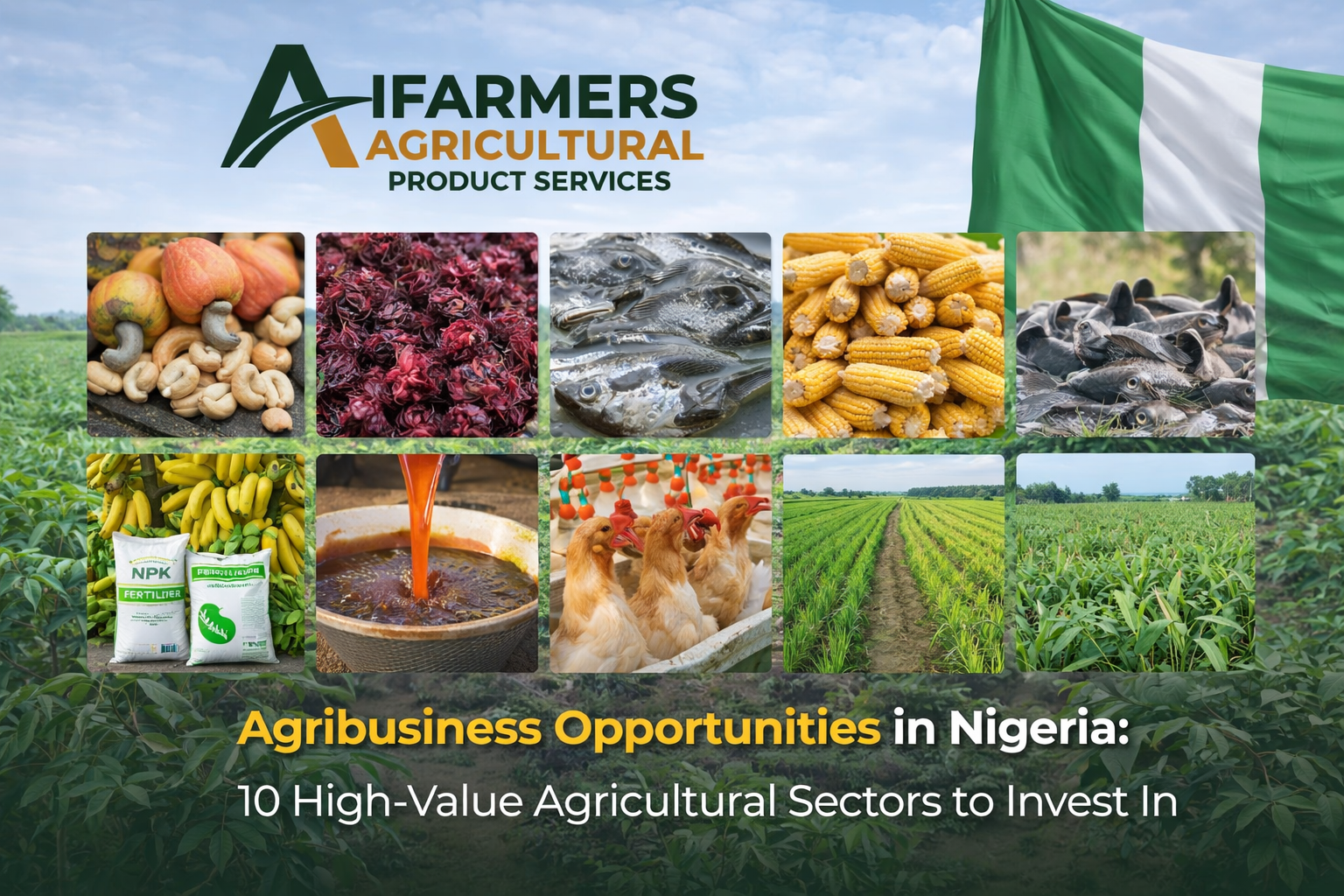
Nigeria's agricultural sector is one of the largest and most diverse on the African continent. With over 84 million hectares of arable land, a population of more than 220 million people generating enormous domestic food demand, and a federal government increasingly prioritising agriculture as a pillar of economic diversification, the opportunities for agribusiness investment in Nigeria have never been more accessible — or more compelling.
Yet many investors, both within Nigeria and in the diaspora, hold back because they do not know which specific sectors offer the best returns, what the realistic entry requirements are, or how to navigate the Nigerian agricultural business environment without being burned. This article addresses all of that directly.
Below are ten high-value agribusiness sectors in Nigeria, what each one involves, what kind of capital and commitment is required, and how Ifarmers Agricultural Products Services Limited can serve as your operational partner across multiple sectors simultaneously.
1. Agricultural Commodity Export
Nigeria produces a wide range of globally demanded agricultural commodities — ginger, sesame seed, cashew nuts, hibiscus (zobo), cocoa, tigernut, soya beans, and groundnuts among them. International buyers in Europe, Asia, and the Americas actively source these commodities from Nigeria year-round.
The opportunity lies in bridging the gap between Nigeria's enormous farm production and the international market. Exporters who understand quality standards, hold the right certifications, and have reliable buyer relationships can earn significant margins on each consignment.
Key considerations:
- NEPC registration and NAQS phytosanitary certification are mandatory — these are non-negotiable entry requirements
- Quality control and proper post-harvest handling determine the price you receive per tonne
- Start with one commodity you understand well before expanding to multiple products
- Partnering with an experienced, certified exporter like Ifarmers is the fastest route to market for first-time entrants
Realistic startup capital ranges from ₦5 million to ₦50 million depending on the commodity, volume, and whether you are sourcing independently or aggregating through an export partner.
2. Fertilizer Supply and Distribution
Nigeria consumes millions of metric tonnes of fertilizer annually, and the gap between government programme supply and actual farmer demand creates a consistent commercial opportunity for private fertilizer suppliers. The demand is not seasonal — it is year-round, with peaks at the major planting seasons.
The opportunity includes:
- Supplying NPK, Urea, and SSP to large-scale farmers, cooperatives, and agribusinesses
- Participating in government and NGO input distribution programmes as an approved supplier
- Custom fertilizer blending for specific crops and soil types — a premium service with strong margins for serious operators
Ifarmers operates as a fertilizer supplier — not a retail agro dealer — and partners with Greenwell Fertilizer, Matrix Fertilizer, and United Fertilizer as blending partners. This is the kind of operational structure that gives a fertilizer business the credibility and capacity to serve institutional clients rather than competing purely on price in the open market.
Startup capital for a serious fertilizer supply business typically starts from ₦20 million and scales significantly with the size of contracts pursued.
3. Custom Fertilizer Blending
Closely related to fertilizer supply but worth treating separately, custom fertilizer blending is a high-value niche within the input supply sector. Rather than trading generic compound fertilizers, blending companies produce tailored NPK formulations for specific crops, soil types, and geographic zones — commanding premium prices and building long-term institutional relationships with state agriculture ministries, ADPs, and development partners.
The market for custom blending in Nigeria is significantly underserved relative to the agronomic need. Most Nigerian farmers are applying generic fertilizer to soils that have been tested and found to need something quite different. The gap between what farmers apply and what their soils actually require is a commercial opportunity waiting to be addressed at scale.
Entry into this sector typically requires:
- Partnership with or investment in a licensed fertilizer blending facility
- Agronomic expertise or access to agronomists who can translate soil test data into blend formulations
- Strong relationships with government and development partner procurement channels
- Capital for raw material procurement — the largest working capital requirement in the blending business
4. Agro Input Supply (Seeds and Agrochemicals)
Beyond fertilizer, Nigerian farmers require improved crop seeds and agrochemicals — herbicides, insecticides, and fungicides — in large quantities every season. The market for quality-assured agro inputs is enormous, and the prevalence of fake and adulterated products in the Nigerian market means that suppliers who can credibly guarantee product quality command strong loyalty from buyers.
Opportunities in this space include:
- Supplying certified improved seeds for rice, maize, soya bean, and other key crops to cooperatives and large farms
- Distributing quality agrochemicals to farmers directly or through government input programmes
- Serving as an implementing partner for development organisations running subsidised input distribution programmes
The key differentiator in this market is verifiable quality assurance. Farmers who receive genuine, effective inputs once become loyal repeat customers. Those who receive fake inputs once rarely give the same supplier a second chance.
5. Agricultural Project Management
As federal and state governments, international development organisations, and private foundations continue to invest in agricultural programmes across Nigeria, the demand for credible, experienced agricultural project management firms is growing steadily.
This is not a sector that requires farmland or physical commodities. It requires expertise, a structured team, documented systems, and a track record that commissioning organisations can verify. The fees are substantial — project management contracts for government and development partner agricultural programmes routinely run into hundreds of millions of naira.
Ifarmers' Agricultural Project Management Unit has executed input distribution programmes across multiple states and holds a UNDP reference letter as evidence of its delivery standard. This kind of track record takes years to build but creates a strong competitive moat once established.
Entry requirements:
- A structured team including a Project Manager, Field Supervisors, Logistics Coordinators, and Community Engagement Officers
- Documented systems for beneficiary management, chain-of-custody input tracking, and programme reporting
- A credible track record — even one or two well-executed programmes create the reference base needed to win subsequent contracts
6. Agritech and Digital Agriculture Platforms
Technology is transforming every segment of Nigeria's agricultural value chain, from farm management and input access to market linkage and investment facilitation. The agritech space in Nigeria is attracting growing investor interest from both local and international capital.
Opportunities in agritech include:
- Platforms that connect smallholder farmers with buyers, eliminating middlemen and improving farm-gate prices
- Digital investment platforms that allow urban professionals and diaspora Nigerians to invest in verified farming projects and earn returns
- Farm monitoring tools using satellite imagery and AI to track crop health, predict yields, and manage risk
- E-commerce solutions for agricultural inputs that improve farmer access to quality products
Ifarmers is actively involved in this space through its agritech initiatives, which include digital farm investment, managed farming services, and AI-powered farm monitoring — making us a relevant partner for investors and development organisations seeking to leverage technology for agricultural impact in Nigeria.
7. Contract Farming and Outgrower Schemes
Contract farming involves a company (the contracting firm) providing inputs, technical assistance, and guaranteed purchase agreements to smallholder farmers, who in turn grow a specified crop to agreed quality standards for delivery to the contracting firm at harvest.
For investors and agribusinesses, contract farming offers:
- Access to large volumes of produce without the capital and management burden of owning and operating large farms
- A structured supply chain that can be scaled progressively as the programme matures
- Alignment with development partner and government priorities around smallholder income improvement, making funding and partnership access easier
The critical success factors for contract farming in Nigeria are strong farmer relationship management, reliable input provision, transparent pricing agreements, and a credible dispute resolution process. Programmes that shortchange farmers on the promised buy price quickly collapse — reputation in farming communities travels fast.
8. Agro Processing and Value Addition
Raw agricultural commodities command significantly lower prices than processed equivalents. Nigeria exports large volumes of raw cashew nuts to India and Vietnam, where they are processed into kernels and sold to retail markets at multiples of the raw nut price. The same dynamic applies to ginger, sesame oil, hibiscus extract, groundnut oil, cassava starch, and dozens of other commodities.
Agro processing presents one of the highest-value agribusiness opportunities in Nigeria precisely because the value addition happens here rather than abroad:
- Cashew processing — shelling, peeling, and grading kernels for direct export to retail markets in Europe and North America
- Ginger processing — slicing, drying, grinding, and packaging ginger for the spice and nutraceutical industry
- Sesame oil extraction — processing sesame seed into oil and meal for the food and cosmetics industries
- Cassava processing — producing starch, flour, and ethanol from cassava for industrial and food applications
The capital requirements for agro processing are higher than for trading, but the margins are substantially better and the business is more defensible once established.
9. Cold Chain and Agricultural Logistics
One of the least glamorous but most consistently profitable segments of Nigerian agribusiness is agricultural logistics — specifically cold chain infrastructure for perishable produce and reliable transport and warehousing for dry commodities.
Nigeria loses an estimated 40 to 45 percent of its fruit and vegetable production annually to post-harvest losses, largely due to inadequate cold storage and logistics infrastructure. Every percentage point of that loss that can be recovered through better logistics infrastructure represents enormous commercial value.
Opportunities include:
- Cold storage facility development at key agricultural production or market hub locations
- Refrigerated transport services for perishable produce moving from farm to urban market or export port
- Commodity warehousing services for dry goods — fertilizer, grains, dried produce — at strategic locations near farming communities or ports
- Logistics services for agro input distribution programmes, a growing market as government and NGO programmes scale up
10. Farm Investment and Agricultural Finance
The final high-value opportunity is perhaps the most accessible for investors who want exposure to Nigerian agriculture without managing operations directly — agricultural investment and finance.
Options in this space include:
- Crowdfunded farm investment platforms — Digital platforms that pool capital from multiple investors to finance verified farming projects, with returns distributed at harvest
- Agricultural lending — Providing working capital financing to established agribusinesses, cooperatives, or input suppliers at commercial interest rates
- Tree crop investment portfolios — Investing in long-cycle tree crops such as cashew, shea, and oil palm that generate returns over multiple seasons
- Joint venture farming arrangements — Partnering with an operational farming company to provide capital in exchange for a defined share of production revenue
The key risk in agricultural investment in Nigeria is counterparty credibility — choosing investment partners or platforms with verifiable track records, proper corporate registration, and transparent reporting systems. Investors should prioritise organisations with NEPC or NAQS certification, audited financials, and established operational histories rather than new entrants making large return promises without documented evidence.
Government Support and Incentives for Nigerian Agribusinesses
Beyond the commercial opportunities themselves, several government and institutional support mechanisms exist to reduce the capital burden and risk for Nigerian agribusiness investors:
- NIRSAL — Provides loan guarantees and insurance products that make agricultural lending more accessible and affordable
- Bank of Agriculture (BOA) — Offers concessionary financing for agricultural businesses at below-commercial interest rates
- Central Bank of Nigeria (CBN) agricultural intervention funds — Various CBN-managed credit facilities targeted at specific agricultural value chains
- Anchor Borrowers Programme — Links smallholder farmers to financial institutions through agribusiness anchor companies
- Nigeria Incentive-Based Risk Sharing System — Reduces lender risk and improves credit access across the agricultural value chain
Navigating these support programmes effectively requires proper business registration, tax compliance, and ideally a relationship with institutions like BOA — all of which are covered in our business registration guide on the Ifarmers blog.
Why Ifarmers Is Your One-Stop Agribusiness Partner
What makes Ifarmers Agricultural Products Services Limited unique among Nigerian agribusinesses is the breadth of operational capability we have built across multiple sectors simultaneously. Rather than specialising narrowly in one activity, Ifarmers has developed credible capacity in agro-commodity export, fertilizer and input supply, agricultural project management, and agritech — meaning investors and development partners can access multiple agribusiness opportunities through a single, trusted, certified partner.
We are NEPC and NAQS certified, registered with the CAC and FIRS, have a Bank of Agriculture account, and have a UNDP reference letter evidencing our project management delivery standard. This is the foundation of a serious agribusiness — and the foundation on which we are ready to partner with investors, development organisations, and government agencies who want to deploy capital into Nigeria's agricultural economy effectively.
Frequently Asked Questions
Which agribusiness sector in Nigeria has the lowest startup capital requirement? Agricultural project management and agro input distribution as a service business have relatively lower fixed capital requirements compared to sectors like processing or fertilizer blending, since they are primarily people, systems, and relationship businesses rather than asset-heavy ones. Agricultural commodity trading and export also has a moderate entry point depending on the commodity and volume. Agro processing and cold chain infrastructure have the highest capital requirements but also some of the strongest long-term margin potential.
Is agricultural investment in Nigeria safe for diaspora Nigerians? Agricultural investment in Nigeria carries real risks — weather, logistics, counterparty, and market risks all exist. However, these risks are manageable when investments are made through credible, properly registered organisations with verifiable track records, transparent reporting, and accountability structures. Diaspora investors should prioritise organisations with corporate registration, audited financials, and established operational histories over platforms making high-return promises without evidence of delivery capability.
Can a foreign company invest in Nigerian agribusiness? Yes. Foreign companies and investors can invest in Nigerian agribusiness either through direct incorporation of a Nigerian entity, a joint venture with an established Nigerian agribusiness, or through a financial investment in an existing Nigerian agricultural operation. The Nigerian Investment Promotion Commission (NIPC) facilitates foreign investment registration, and most agricultural sectors are open to foreign investment without restriction.
How do I evaluate whether an agribusiness opportunity in Nigeria is genuine? Verify the company's CAC registration number on the CAC portal, confirm their TIN with FIRS, check for relevant sector certifications (NEPC for exporters, NAQS for agricultural handlers), request audited financial statements, and ask for verifiable client references from previous projects or buyers. Any serious agribusiness should be able to provide all of these without hesitation.
Start Your Agribusiness Journey in Nigeria Today
Nigeria's agricultural sector is not a future opportunity — it is a present one. The demand is here, the production capacity is here, and the support infrastructure is improving. What is needed is serious, informed investment backed by credible operational partners who know the terrain.
Ready to explore agribusiness opportunities in Nigeria? Contact Ifarmers Agricultural Products Services Limited — a fully certified, multi-sector agribusiness based in Abuja, FCT, with over 7 years of operational experience across commodity export, input supply, project management, and agritech.
📍 Amb. I. Osakwe House, Inner Block St, CBD, Abuja, FCT, Nigeria 🌐 www.ifarmerslimited.com