
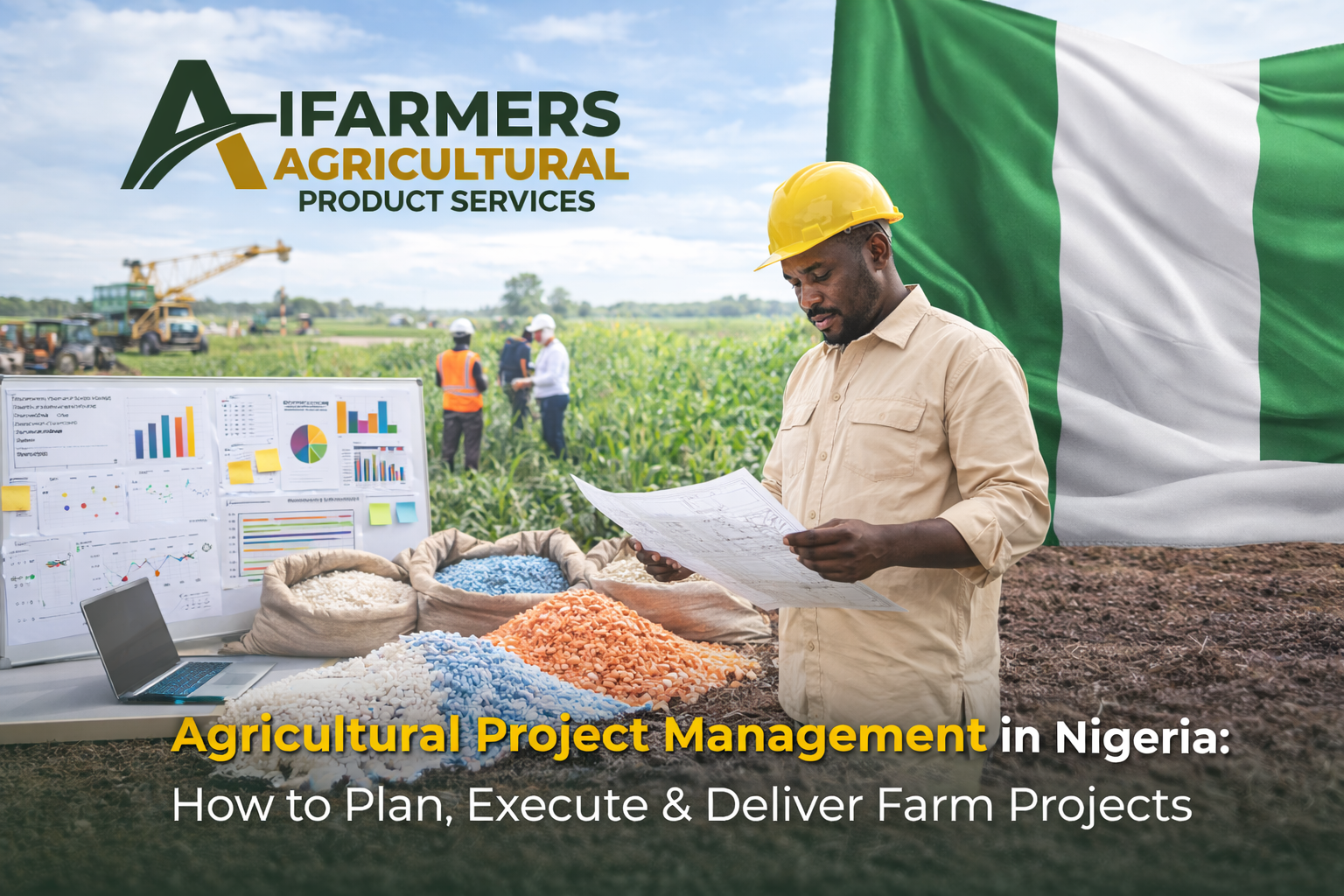
Nigeria has no shortage of agricultural projects. From federal and state government input distribution programmes to international NGO-funded food security initiatives and private agribusiness expansions, billions of naira and dollars are committed to agricultural development in Nigeria every year. Yet a significant proportion of these projects underdeliver — not because the funding was insufficient or the need was not real, but because the project management was poor.
Procurement was delayed. Inputs arrived after the planting window closed. Field supervisors were not deployed correctly. Farmers were not properly engaged. Reporting was incomplete. These are not agricultural failures — they are project management failures, and they are entirely preventable.
Whether you are a government agency, an international development organisation, an NGO, or a private agribusiness planning a farm project in Nigeria, understanding what professional agricultural project management looks like — and what it requires — is the difference between a project that delivers results and one that produces reports but not outcomes.
What Is Agricultural Project Management?
Agricultural project management is the structured application of planning, coordination, and oversight principles to the execution of farming and agribusiness projects. It covers everything from initial needs assessment and budgeting through procurement, field implementation, monitoring, and final reporting.
It is distinct from simply managing a farm. A farm manager is responsible for ongoing, cyclical operations on a defined piece of land. An agricultural project manager is responsible for delivering a defined set of outcomes — to a defined group of beneficiaries, within a defined timeframe, on a defined budget — and then documenting that those outcomes were achieved.
The clients for professional agricultural project management in Nigeria fall into three broad categories:
- Government agencies — Federal and state ministries of agriculture, agricultural development programmes (ADPs), and agencies running food security, input distribution, or rural development mandates
- International development organisations — Bodies such as the UNDP, World Bank, FAO, USAID, IFAD, and the Bill & Melinda Gates Foundation that fund agricultural interventions in Nigeria and need credible, experienced local implementing partners
- Private agribusinesses — Companies establishing new farming operations, expanding existing ones, or executing contract farming programmes that require systematic planning, input procurement, and field supervision
The Agricultural Project Management Framework
Professional agricultural project management in Nigeria follows a structured framework that covers every phase of a project from inception to close-out. Here is how each phase works in practice:
Phase 1 — Needs Assessment and Project Design
- Conduct a thorough assessment of the target area, target beneficiaries, existing agricultural conditions, and the specific problem the project is designed to solve
- Define clear, measurable project objectives — not vague aspirations but specific outcomes (e.g., "distribute 500 metric tonnes of NPK fertilizer to 10,000 registered smallholder farmers across five LGAs before the April planting season")
- Identify key stakeholders: government counterparts, community leaders, farmer cooperative heads, and local government offices whose cooperation is essential for smooth implementation
- Assess logistical realities on the ground: road access, warehouse availability, local market conditions, and seasonal constraints that will affect the project timeline
Phase 2 — Budget Development and Procurement Planning
- Develop a detailed project budget covering all input costs, logistics, personnel, monitoring, and reporting
- Prepare a procurement plan that identifies what needs to be purchased, from whom, at what cost, and by what date — working backwards from field delivery dates to allow sufficient lead time
- Identify and pre-qualify reliable suppliers for fertilizer, seeds, agrochemicals, and other inputs well in advance of the procurement window — supplier failure is one of the most common causes of agricultural project delays in Nigeria
- Build contingency provisions into the budget for logistics disruptions, price fluctuations, and field-level challenges that are almost certain to arise in Nigerian agricultural contexts
Phase 3 — Field Execution and Input Distribution
- Deploy a structured field team covering logistics coordination, farmer registration and verification, warehouse management, and last-mile delivery
- Verify beneficiary lists against registration data before distributing any inputs — phantom beneficiary lists are a significant accountability problem in Nigerian agricultural programmes
- Establish clear chain-of-custody documentation for all inputs from the point of procurement through to farmer receipt — every bag of fertilizer, every tin of seed, every litre of agrochemical must be traceable
- Manage community engagement proactively — farmers who understand the programme, trust the implementing organisation, and feel their concerns are heard are far more cooperative during distribution and more likely to use inputs correctly
Phase 4 — Monitoring and Evaluation
- Conduct regular field monitoring visits to verify that inputs are being distributed as planned and being correctly used by beneficiaries
- Collect beneficiary feedback systematically — complaints, suggestions, and field observations are valuable data that allow mid-course corrections before problems escalate
- Track key performance indicators against the project's defined objectives throughout implementation, not just at the end
- Document everything — photographs, signed receipt forms, attendance registers, field reports — as evidence of delivery that will be required in the final report
Phase 5 — Reporting and Close-Out
- Compile a comprehensive final project report documenting what was planned, what was executed, what was achieved, and what lessons were learned
- Provide financial documentation accounting for all project expenditure against the approved budget
- Conduct a beneficiary satisfaction assessment to capture farmer feedback on the quality of inputs received and the effectiveness of the distribution process
- Archive all project documentation in an organised manner for audit, reference, and learning purposes
Key Challenges in Nigerian Agricultural Project Management
Understanding the specific challenges of implementing agricultural projects in Nigeria is essential for any project manager or commissioning organisation:
- Logistics and last-mile access — Getting inputs from a central warehouse in a state capital to farmers in remote rural LGAs is often the most difficult and expensive part of any agricultural project. Road conditions, seasonal flooding, and limited local transport capacity make logistics planning critical.
- Farmer engagement and trust — Many Nigerian smallholder farmers have had negative experiences with government and NGO programmes that promised inputs and did not deliver, or delivered late and in poor condition. Building trust and communicating clearly and consistently is not a soft issue — it directly affects project outcomes.
- Fake and adulterated inputs — Purchasing fertilizer, seeds, or agrochemicals from unvetted suppliers risks distributing inputs that are expired, substandard, or outright fake. Rigorous supplier pre-qualification and quality verification at the point of receipt are non-negotiable.
- Seasonal timing pressure — Agricultural projects are uniquely time-sensitive. Missing the planting window by even two weeks can render an entire season's input distribution agronomically useless, regardless of how well everything else was executed. Every element of the project plan must be built around the farming calendar, not the administrative calendar.
- Documentation and accountability gaps — Many agricultural projects in Nigeria are poorly documented, making it difficult to account for inputs, demonstrate results to funders, or learn from what went wrong. Professional project management closes this gap systematically.
Ifarmers' Agricultural Project Management Capability
Ifarmers Agricultural Products Services Limited has a dedicated Agricultural Project Management Unit that has executed input distribution programmes across multiple Nigerian states, reaching thousands of smallholder farmers through government and development partner-funded programmes.
Our track record includes input distribution under government agricultural programmes in Ekiti, Ogun, Abia, and Imo states, and we have received a reference letter from the UNDP in recognition of our project management and delivery capability — a testament to the standard of implementation our team maintains.
Our project management structure includes:
- A dedicated Project Manager with experience in government and development partner agricultural programmes
- Field Supervisors deployed across project states to oversee distribution and monitor beneficiary engagement
- Extension Officers who provide agronomic support to beneficiary farmers on correct input use
- Community Engagement Officers who manage relationships with farmer groups, cooperative leaders, and local government counterparts
- Logistics Coordinators and a Warehouse Manager responsible for input movement, storage, and chain-of-custody documentation
This structure means that when Ifarmers takes on an agricultural project management mandate, the client is engaging a team — not an individual — with the depth and field presence to deliver at scale.
Why Professional Project Management Pays for Itself
Some commissioning organisations — particularly government agencies — view professional project management fees as an overhead cost to be minimised. This is a false economy. Consider the cost of the alternative:
- Inputs procured from unvetted suppliers and found to be substandard after distribution — entire programme cost wasted
- Beneficiary lists not properly verified — inputs reaching non-farmers rather than the intended smallholders
- Distribution delayed past the planting window — inputs received by farmers too late to affect that season's yield
- Poor documentation — funders unable to account for programme expenditure, leading to audit queries, withheld tranches, or programme cancellation
Professional agricultural project management eliminates or significantly reduces all of these risks. The management cost is a fraction of the total programme budget. The cost of poor management is often the entire programme budget, plus reputational damage that affects future funding.
Frequently Asked Questions
What is the difference between agricultural project management and farm management? Farm management is the day-to-day operational running of a specific farm — crop rotation decisions, labour scheduling, input application, and harvest coordination on a defined piece of land. Agricultural project management is about delivering defined outcomes for a defined group of beneficiaries within a fixed timeframe and budget, which may involve multiple farms, multiple states, and multiple input types. Project management has a beginning, a middle, and an end with defined deliverables; farm management is an ongoing operational role.
Can a private agribusiness use agricultural project management services, or is it only for government and NGOs? Agricultural project management is highly relevant for private agribusinesses, particularly those establishing outgrower or contract farming programmes, setting up new large-scale farming operations in unfamiliar locations, or managing complex input procurement and distribution supply chains. Any operation that involves delivering defined agricultural outcomes across multiple sites or to multiple farmer beneficiaries benefits from structured project management.
How does Ifarmers ensure that inputs reach the right farmers and are not diverted? Ifarmers uses a documented chain-of-custody system for all input distribution. This includes pre-verified beneficiary lists checked against registration data, signed farmer receipt forms collected at the point of distribution, field supervision at distribution points, and photographic documentation of distribution activities. These controls are designed to ensure that every bag of fertilizer or input package distributed can be traced from procurement to beneficiary receipt.
What is the minimum project size that justifies professional agricultural project management? There is no absolute minimum, but practically speaking, agricultural projects involving input distribution to 500 or more farmers, covering more than one LGA, or managing procurement budgets above ₦50 million benefit most from professional project management. Below this scale, a well-organised in-house team with clear processes may be sufficient. Above it, the complexity of logistics, documentation, beneficiary management, and reporting makes professional project management a sound investment.
Partner With Ifarmers for Your Next Agricultural Project
Agricultural project management in Nigeria requires local knowledge, an established field presence, trusted supplier relationships, and a proven documentation and accountability system. These are not capabilities that can be improvised — they are built through years of on-the-ground experience.
Looking for a reliable agricultural project management partner in Nigeria? Whether you are a government agency, an international development organisation, or a private agribusiness, Ifarmers Agricultural Products Services Limited has the team, the systems, and the track record to plan, execute, and deliver your agricultural project to the standard your beneficiaries and funders expect.
📍 Amb. I. Osakwe House, Inner Block St, CBD, Abuja, FCT, Nigeria 🌐 www.ifarmerslimited.com 📞 [Insert WhatsApp Number]
Written by Alderwood Management Limited on behalf of Ifarmers Agricultural Products Services Limited. Explore related articles: Agro Input Distribution in Nigeria, Agribusiness Opportunities in Nigeria, and How to Register a Farm Business in Nigeria — all on the Ifarmers blog.