
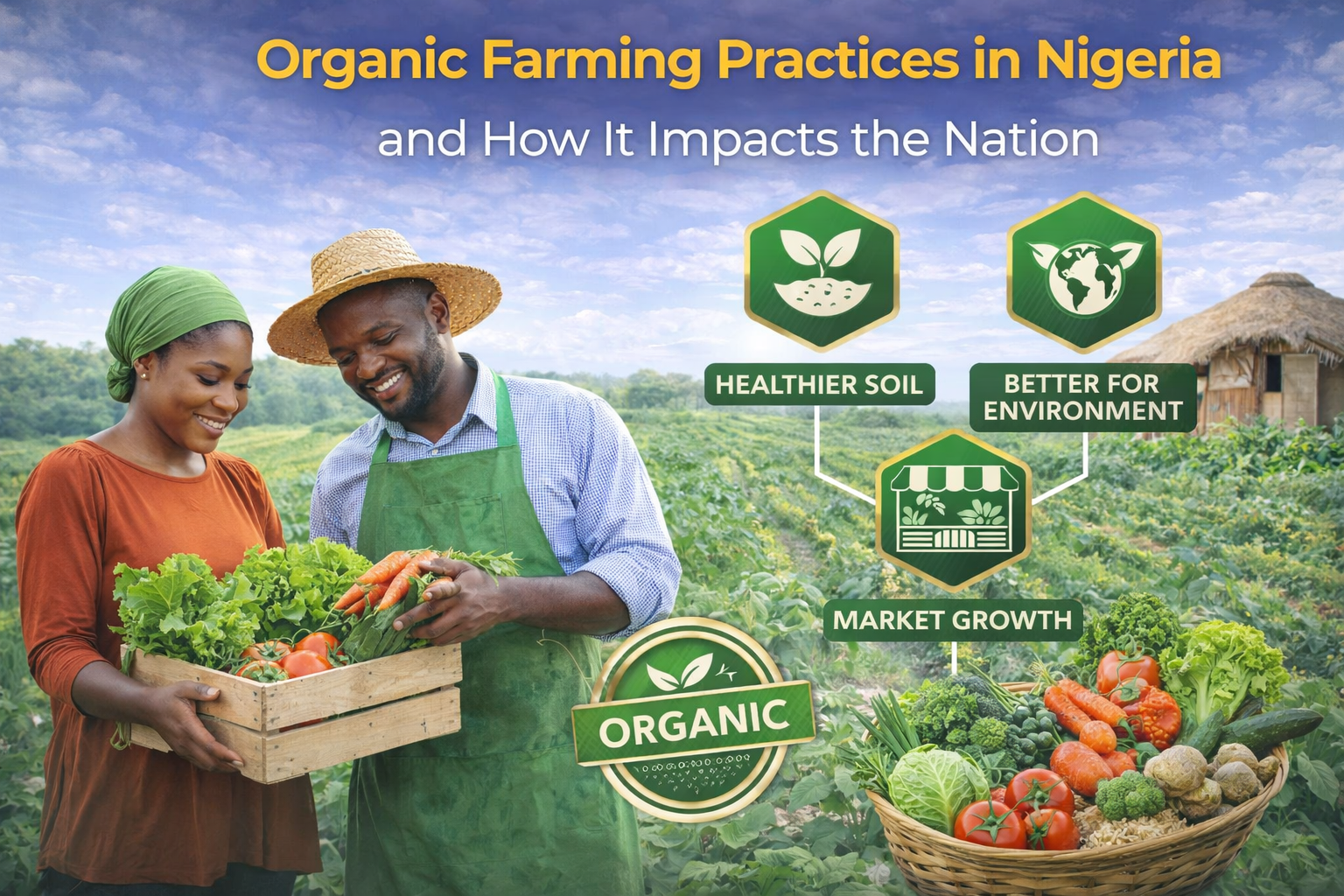
Nigeria's agricultural sector is at a crossroads. On one side is the pressure to produce more food faster — using synthetic fertilizers, chemical pesticides, and high-input farming systems to feed a population exceeding 220 million and growing. On the other side is a growing body of evidence — and a growing global market — pointing in a different direction: toward farming systems that produce food in harmony with natural ecological processes rather than in opposition to them.
Organic farming is not a new concept in Nigeria. In many ways, traditional Nigerian farming before the Green Revolution era of the 1970s was organic by default — farmers used animal manure, crop rotation, intercropping, and fallow periods to maintain soil health without synthetic inputs. What is new is the formalisation of organic practice, the development of organic certification systems, and the emergence of both domestic and international markets willing to pay a premium for certified organic Nigerian agricultural produce.
This article explores what organic farming actually means in the Nigerian context, the practices it involves, the impact it is having on Nigerian farmers, food systems, and the natural environment, and what the growing organic sector means for exporters, investors, and agribusinesses operating in Nigeria's agricultural economy.
What Is Organic Farming?
Organic farming is an agricultural system that produces food using only naturally derived inputs and ecological processes — without synthetic chemical fertilizers, synthetic pesticides, genetically modified organisms (GMOs), or synthetic growth regulators.
The core principles of organic farming, as defined by the International Federation of Organic Agriculture Movements (IFOAM), are:
- Health — Organic farming sustains and enhances the health of soil, plants, animals, people, and the planet as one and indivisible system
- Ecology — Organic farming is based on living ecological systems and cycles — working with them, emulating them, and supporting them rather than overriding them with chemical inputs
- Fairness — Organic farming builds relationships that ensure fairness with regard to the natural environment and life opportunities
- Care — Organic farming is managed in a precautionary and responsible manner to protect the health and wellbeing of current and future generations
In practical terms for a Nigerian farmer, organic farming means managing soil fertility through compost, animal manure, green manures, and crop rotation; controlling pests and diseases through biological controls, resistant varieties, and cultural practices; and producing food that meets the documented standards required for organic certification.
Organic Farming Practices Used in Nigeria
1. Composting and Organic Manure Application
Rather than applying synthetic NPK fertilizers to supply crop nutrients, organic farmers build soil fertility through the decomposition of organic matter:
- Farm waste — crop residues, husks, stalks — is composted and returned to the soil as a nutrient-rich amendment that feeds both the crop and the soil microbial community
- Animal manure from cattle, poultry, and small ruminants is incorporated into the soil ahead of planting as a primary nitrogen and phosphorus source
- Vermicompost — worm-processed organic matter — is increasingly used by smallholder organic farmers for its high nutrient density and beneficial microbial content
- Green manures — fast-growing leguminous plants (such as mucuna and tithonia) that are grown and then incorporated into the soil — fix atmospheric nitrogen and add organic matter simultaneously
2. Crop Rotation and Intercropping
Monoculture farming — growing the same crop on the same land year after year — depletes specific soil nutrients and builds up crop-specific pest and disease pressure. Organic farming addresses this through:
- Crop rotation — alternating crops across seasons so that the nutrient demands and pest pressures of each crop are balanced over time
- Legume rotation — including nitrogen-fixing legumes (cowpea, soya bean, groundnut) in the rotation sequence to naturally replenish soil nitrogen
- Intercropping — growing two or more crops simultaneously in the same field, which improves land use efficiency, reduces pest monoculture pressure, and provides a diversified income stream for the farmer
3. Biological Pest and Disease Control
Without synthetic pesticides, organic farmers manage pests and diseases through:
- Beneficial insect conservation — maintaining habitat for predatory insects (such as ladybirds and parasitic wasps) that naturally suppress pest populations
- Botanical pesticides — plant-derived repellents and pesticides such as neem oil (Azadirachta indica), which is widely used in Nigeria as an organic insect deterrent
- Trap cropping — planting sacrificial crops at field borders to attract pests away from the main crop
- Cultural controls — timely planting, proper spacing, and prompt removal of diseased plant material to reduce pest and disease incidence
4. Soil Conservation and Water Management
Organic farming places particular emphasis on maintaining and improving soil physical structure:
- Mulching — covering the soil surface with organic materials (straw, crop residues, dried leaves) to conserve moisture, suppress weeds, and feed the soil as the mulch decomposes
- Minimum tillage — reducing soil disturbance during land preparation to preserve soil structure and the microbial communities that drive nutrient cycling
- Contour farming and cover crops — managing water flow across sloped land to reduce erosion and maintain topsoil integrity
The Impact of Organic Farming on Nigerian Farmers
Economic Impact:
The most immediate question for any Nigerian farmer considering organic practice is whether it pays. The honest answer involves both an opportunity and a transition challenge:
- Certified organic commodities command meaningful price premiums in international markets — organic sesame seed, organic ginger, organic hibiscus, and organic tigernut can fetch 20 to 40 percent above conventional equivalents with the right buyers
- Reduced dependency on purchased synthetic inputs lowers ongoing production costs for organic farmers, particularly as synthetic fertilizer and agrochemical prices have risen sharply in Nigeria in recent years
- The transition period — the 2 to 3 years required to convert land from conventional to certified organic without being able to sell at organic prices yet — is the most financially challenging phase for farmers making the switch
- Access to the organic premium requires formal organic certification through an accredited body, which involves inspection costs and documentation requirements that can be a barrier for individual smallholders without cooperative or programme support
Social and Community Impact:
- Organic farming systems, with their emphasis on traditional ecological knowledge and labour-intensive biological management, tend to preserve and build on indigenous Nigerian farming knowledge rather than replacing it
- Intercropping and diversified organic systems provide more diversified food and income sources for smallholder farming households than monoculture cash crop systems
- Reduced chemical exposure — particularly the elimination of synthetic pesticide handling — meaningfully improves health outcomes for farm workers and their families in rural communities
- Women farmers in Nigeria, who represent a significant proportion of smallholder food producers, often have stronger familiarity with traditional organic-type practices and benefit disproportionately from programmes that formalise and reward these approaches
The Impact of Organic Farming on Nigeria's Natural Environment
Soil Health:
Nigeria's agricultural soils have been under increasing stress from decades of intensive conventional farming in many areas. Organic farming's impact on soil health is one of its most significant environmental contributions:
- Regular addition of organic matter through compost, manure, and crop residues rebuilds soil organic carbon — which has been declining in many Nigerian farming areas under continuous synthetic input use
- Higher soil organic matter improves water retention, particularly important in Nigeria's drier agricultural zones where drought stress is a recurring production challenge
- Diverse crop rotations and minimum tillage support soil biodiversity — the bacteria, fungi, earthworms, and other organisms that drive nutrient cycling, disease suppression, and soil structural improvement
Water Quality:
- The elimination of synthetic fertilizer and pesticide applications under organic systems reduces the risk of nutrient runoff into waterways — a growing concern in intensively farmed areas near Nigeria's river systems
- Higher soil organic matter under organic management improves water infiltration, reducing surface runoff and the associated erosion and sedimentation that degrade water quality downstream
Biodiversity:
- Organic farms consistently support higher levels of plant and animal biodiversity than conventionally managed farms — more wild plant species at field margins, more insect diversity, and more bird activity
- In Nigeria's increasingly fragmented agricultural landscapes, organic farms function as biodiversity refugia that support populations of beneficial insects and wildlife that conventional monoculture farms cannot sustain
Organic Farming and Nigeria's Export Opportunity
The global organic food and drink market has been growing consistently for over two decades and shows no sign of slowing. European consumers — Nigeria's most important agricultural export market — have particularly strong and growing demand for certified organic agricultural ingredients.
Nigeria is exceptionally well positioned to capitalise on this trend:
- Many Nigerian smallholder farmers already farm in ways that are substantially organic by practice — without the synthetic inputs that would disqualify their produce from organic status — but without the certification that would allow them to access the organic price premium
- Several of Nigeria's key export commodities — sesame seed, ginger, hibiscus, tigernut, and shea — have strong and growing demand in the certified organic segment of international markets
- The combination of low existing synthetic input use in many farming communities and the growing technical support for organic certification in Nigeria means the gap between current practice and certifiable organic status is narrower than in many other agricultural economies
The main missing pieces are:
- Farmer awareness of organic certification pathways and the price premiums available
- Collective action through cooperatives to make certification economically viable for individual smallholders
- Exporters and supply chain partners who can aggregate, certify, and market certified organic Nigerian commodities to the international buyers who want them
Fertilizer in Organic Farming: What Ifarmers Supplies
Organic farming does not mean farming without inputs — it means farming without synthetic inputs. Organic-approved fertilizer products play an important role in maintaining soil fertility in certified organic systems, and the demand for these products is growing as more Nigerian farmers explore organic transition.
Ifarmers Agricultural Products Services Limited supplies fertilizer inputs to Nigerian farmers including organic and naturally derived nutrient products suitable for use in organic and transitional farming systems. As a fertilizer supplier partnering with Greenwell Fertilizer, Matrix Fertilizer, and United Fertilizer, Ifarmers is positioned to support farmers seeking input solutions that align with organic management principles — alongside our conventional NPK, Urea, and SSP supply for farmers operating in conventional systems.
Farmers exploring organic transition who need guidance on which input products are compatible with organic certification requirements should contact us directly for a consultation.
Challenges Facing Organic Farming in Nigeria
Despite its potential, organic farming in Nigeria faces several real constraints that limit its current scale:
- Certification cost and complexity — Organic certification requires annual inspection by an accredited certification body, documentation of all farm inputs and practices, and a mandatory conversion period during which the farmer bears the costs of organic management without yet receiving the organic price premium
- Limited awareness among farmers — Many Nigerian farmers with essentially organic practices are unaware that their methods could qualify for certification and premium pricing with the right documentation and support
- Pest and disease pressure — Without synthetic pesticide options, organic farmers in high-pressure pest environments — particularly those growing vegetables and high-value horticultural crops — face more difficult management challenges
- Market access gaps — Even certified organic Nigerian farmers struggle to connect with the international buyers willing to pay the organic premium without the support of an experienced export partner who can navigate certification documentation and buyer requirements
- Input availability — Quality compost, certified organic biological inputs, and organic-approved fertilizer products are not as widely available or as consistently priced as conventional synthetic inputs in many parts of Nigeria
Frequently Asked Questions
Is traditional Nigerian farming the same as organic farming? Traditional Nigerian farming practices — crop rotation, intercropping, use of animal manure, fallow periods — are similar to organic practices in many respects and often meet the substantive requirements for organic management. However, traditional farming is not automatically certified organic. Formal organic certification requires documented proof that no prohibited inputs have been used for a defined period (typically 2 to 3 years), which must be verified by an accredited inspection body. So while many traditional Nigerian farmers farm organically in practice, they cannot sell at organic prices without completing the formal certification process.
How long does organic certification take in Nigeria? The conversion period from conventional to certified organic farming is typically 2 to 3 years, during which the land must be managed according to organic standards but the produce cannot yet be sold as certified organic. After the conversion period, farms that pass inspection by an accredited certification body receive organic certification, which is then renewed annually. Working through a cooperative or group certification programme — where multiple farmers are certified collectively — significantly reduces the per-farmer cost of the process.
Which Nigerian export commodities have the strongest organic price premium? Sesame seed, ginger, hibiscus calyces, tigernut, and shea butter are among the Nigerian commodities with the most active certified organic buyer interest in international markets — particularly in the EU, USA, and Japan. Organic sesame and organic hibiscus in particular have well-established premium market segments in the European herbal ingredient and natural food industries. The premium for certified organic product typically ranges from 20 to 40 percent above conventional equivalents, though it varies by commodity and market.
Can a smallholder farmer in Nigeria access organic markets without large capital? Individual certification is financially challenging for a smallholder farming less than 2 hectares. The most practical route for smallholders is group or participatory guarantee system (PGS) certification through a cooperative or farmer group, where certification costs are shared across many members and the inspection covers the group collectively rather than each farm individually. Development organisations and some export companies also sponsor organic certification programmes for smallholder farmer groups in exchange for supply commitments. Contact Ifarmers for information on organic supply chain programmes we are engaged with.
Organic Farming Is Both an Environmental Commitment and a Commercial Opportunity
Organic farming in Nigeria is not simply an idealistic environmental position — it is an increasingly commercial one. The global market is willing to pay more for certified organic Nigerian agricultural commodities than it pays for conventional equivalents. Nigeria's farming communities in many cases already have the practices — what they lack is the certification, the market connections, and the supply chain support to translate those practices into premium prices.
The environmental benefits — healthier soils, cleaner water, greater biodiversity, reduced chemical exposure for farming families — are genuine and significant for a country where agricultural land is under increasing pressure. The commercial benefits — premium international prices, growing export demand, reduced input cost dependency — make the organic transition a financially rational choice for farmers and supply chain partners who approach it strategically.
Looking for fertilizer inputs compatible with organic farming, or interested in connecting with organic commodity buyers for Nigerian produce? Contact Ifarmers Agricultural Products Services Limited — a NEPC and NAQS-certified agro-exporter and fertilizer supplier based in Abuja, FCT, serving farmers, cooperatives, and agribusiness partners across Nigeria.
📍 Amb. I. Osakwe House, Inner Block St, CBD, Abuja, FCT, Nigeria 🌐 www.ifarmerslimited.com