
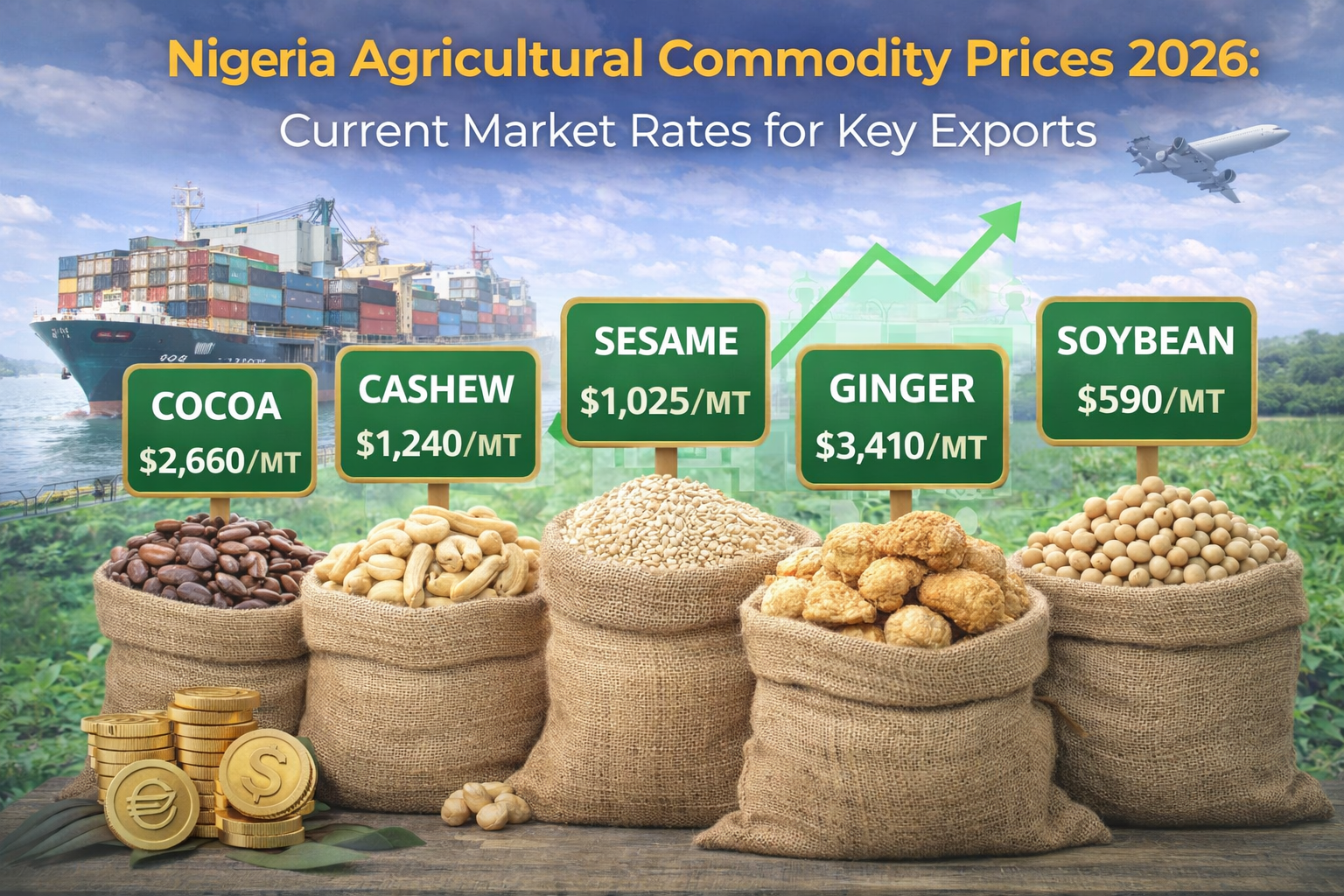
Whether you are a farmer deciding which crop to grow next season, a trader assessing whether now is the right time to sell, or an investor evaluating the commercial potential of an agro-export venture, agricultural commodity prices are the number that everything else is built around. Yet reliable, up-to-date price information for Nigerian agricultural export commodities is surprisingly difficult to find in one place.
Most Nigerian farmers still rely on word of mouth, local market visits, or phone calls to traders to get a sense of what their commodity is worth. This information asymmetry consistently disadvantages producers — who often sell at the lower end of the price range simply because they do not know what buyers are paying elsewhere.
This article provides current indicative market price ranges for Nigeria's key agricultural export commodities, explains the factors that cause prices to move up or down, and identifies the market intelligence you need to time your sales and negotiations effectively.
Important note: Agricultural commodity prices change frequently — influenced by exchange rates, seasonal supply, global demand, and quality factors. The ranges provided here are indicative market estimates based on available trade data. Always verify current prices with active market participants before making commercial decisions. Ifarmers publishes updated commodity price intelligence regularly — contact us directly for the most current market rates.
What Drives Agricultural Commodity Prices in Nigeria
Before looking at specific commodities, it is essential to understand the factors that cause Nigerian agricultural commodity prices to fluctuate — because knowing why prices move helps you anticipate changes rather than simply react to them after the fact.
- Exchange rate movements — Most Nigerian agricultural export commodities are priced in USD or international market equivalents. When the naira depreciates against the dollar, naira-denominated commodity prices rise even if international USD prices remain flat. This means currency movements are often as important as crop conditions in determining what a Nigerian commodity seller receives.
- Seasonal supply — Commodity prices typically fall during and immediately after harvest when supply is abundant, and rise during the off-season when stocks thin out. Sellers who can store properly and sell in the off-season consistently earn better prices than those forced to sell at harvest.
- International market demand — Nigerian commodities compete in global markets. When China, India, Europe, or the Middle East increase their buying activity — due to their own crop shortfalls, growing consumption, or strategic stockpiling — Nigerian export prices rise. When these markets slow down, prices soften.
- Quality and grade — Price ranges are wide precisely because quality variation within the same commodity is enormous. High-moisture sesame seed may sell for 30 to 40 percent less than properly dried, low-foreign-matter sesame of the same variety. Quality is not just a buyer preference — it is a direct price multiplier.
- Global logistics and freight costs — Shipping costs from Nigerian ports to destination markets affect the competitiveness of Nigerian commodities relative to competing origins. When freight costs rise globally, buyers become more price-sensitive and the net price to Nigerian sellers is compressed.
- Domestic supply chain conditions — Fuel prices, road conditions, and the availability of trusted aggregators and logistics providers all affect the farm-gate to port-gate spread — the difference between what a farmer receives and what an exporter earns from the same commodity.
Indicative Price Ranges for Key Nigerian Export Commodities
Ginger
Nigerian ginger — grown primarily in Kaduna, Nasarawa, and Benue states — commands strong international prices when quality standards are met. Dried split ginger and dried whole ginger are the most commonly traded forms for export.
- Dried split ginger (export grade, low moisture) is currently trading in the range of ₦1,200 to ₦1,800 per kilogram at Nigerian aggregation points, with international prices in the range of $1,200 to $1,800 per metric tonne depending on quality and destination market
- Dried whole ginger trades at a slight discount to split ginger due to higher moisture risk in transit
- Ground ginger (powdered) commands a premium over dried whole or split ginger when produced to food-grade specifications for the EU and US spice industry
- Key price drivers: EU and US seasonal demand, Nigerian harvest volume, moisture content, and freedom from aflatoxin
- Best selling window: prices tend to be strongest in the first quarter of the year before the new season's supply enters the market
Sesame Seed
Sesame seed remains one of Nigeria's most consistently valuable non-oil agricultural exports, with strong year-round demand from East Asian markets.
- White sesame seed (export grade, 6% moisture maximum, 98% purity) is currently trading in the range of ₦1,500 to ₦2,200 per kilogram at aggregation points in northern Nigeria
- Brown (natural) sesame trades at a discount of approximately 15 to 25 percent below white sesame of equivalent quality
- Hulled sesame commands a significant premium — often 40 to 60 percent above natural sesame — reflecting the additional processing and the premium markets it accesses in Japan and South Korea
- Key price drivers: Chinese and Japanese import demand, harvest volume in Jigawa and Borno states, moisture content, and foreign matter percentage
- Price volatility is moderate — sesame has consistent baseline demand but is subject to periodic spikes when major importing countries increase procurement activity
Cashew Nuts
Nigerian cashew is one of Africa's most commercially significant export commodities, with the harvest season (March to June) representing the highest-value trading window.
- Raw Cashew Nuts (RCN) with a KOR (Kernel Outturn Ratio) of 48 and above are currently trading in the range of ₦700 to ₦1,100 per kilogram at farm gate and aggregation points
- RCN with lower KOR (below 44) trades at a meaningful discount as processors extract less usable kernel per bag
- Processed cashew kernels (W320 grade) command significantly higher value — in the range of $4,500 to $6,500 per metric tonne depending on destination market and grade
- W240 and W210 premium large kernels fetch prices at the upper end of the range and above, particularly for retail-packaged product targeting European and North American markets
- Key price drivers: Indian and Vietnamese processor demand, seasonal harvest volumes, KOR quality, and global snack food industry trends
Hibiscus (Dried Zobo Calyces)
Dried hibiscus is among Nigeria's most underutilised high-value export commodities — premium prices are available for exporters who meet quality standards.
- Deep red, whole hibiscus calyces with moisture below 12% and low foreign matter are currently trading in the range of ₦1,800 to ₦3,000 per kilogram for export-grade product
- Faded, brown, or high-moisture hibiscus trades at a steep discount — sometimes 40 to 50 percent below premium quality — reflecting the direct impact of drying and handling quality on price
- Organically certified hibiscus commands a premium of 20 to 40 percent above conventional product, particularly with EU herbal tea brands
- Key price drivers: EU and US herbal tea industry demand, colour intensity, moisture content, and whether calyces are whole or broken
- Demand is growing consistently — hibiscus as a natural colouring and health ingredient is an expanding market globally
Soya Beans
Soya bean production is expanding rapidly across Nigeria's middle belt states, and export demand — particularly from processors in neighbouring West African countries and further afield — is growing in parallel.
- Export-grade soya beans (low moisture, high protein, low foreign matter) are currently trading in the range of ₦600 to ₦900 per kilogram at northern and middle belt aggregation points
- Soya bean meal (a processed product from oil extraction) commands higher prices per tonne than raw beans due to the value addition of oil extraction
- Key price drivers: West African regional demand, global soya meal protein market, and competition from South American soya bean supply in international markets
- Nigerian soya is competitively positioned in the West African and North African regional market where proximity gives it a freight cost advantage over South American origins
Tigernut
Tigernut (ofio in Yoruba, aya in Hausa) is a growing export commodity with strong demand from Spain — the world's largest consumer of tigernut, where it is used to produce the traditional drink horchata de chufa — as well as from health food markets in Europe and North America.
- Export-grade dried tigernut is currently trading in the range of ₦800 to ₦1,400 per kilogram at aggregation points
- Quality parameters that determine price: moisture content, size uniformity, freedom from mould and foreign matter, and sweetness profile
- Key price drivers: Spanish horchata industry demand, growing European and North American health food market consumption, and seasonal supply from northern Nigeria
- Tigernut is a niche but consistently premium commodity for exporters who can meet buyer specifications — competition among Nigerian exporters is lower than for mainstream commodities like sesame or cashew
Cocoa
Cocoa remains one of Nigeria's oldest and most established export commodities, with production concentrated in Ondo, Ogun, Cross River, and Edo states.
- Nigerian cocoa is currently trading in the range of ₦3,500 to ₦5,500 per kilogram for Grade 1 fermented, dried cocoa beans at Lagos and Port Harcourt export points
- International cocoa prices have been at historically elevated levels in 2024 and into 2025 due to supply shortfalls from West African producing countries, though prices can adjust significantly with changes in Ivory Coast and Ghana production
- Grade matters enormously — properly fermented, sun-dried Grade 1 cocoa with low defect counts commands significant premiums over poorly processed, under-fermented beans
- Key price drivers: global chocolate industry demand, Ivory Coast and Ghana supply conditions (which set the global reference price), and Nigerian cocoa quality and certification status
How Quality Directly Affects the Price You Receive
The price ranges above represent the spread between low-quality and high-quality product within the same commodity. It is worth being explicit about how large this gap can be in practice:
- Sesame seed with 10% moisture versus sesame with 6% moisture: the high-moisture product may sell for 25 to 35% less — or be rejected entirely
- Cashew with KOR 44 versus KOR 50: the lower outturn attracts a meaningful price deduction from processors who are buying kernel yield, not shell weight
- Hibiscus with faded brown calyces versus deep red whole calyces: the premium for colour-preserved product can be 50% or more above the discount grade
- Ginger with visible mould or above-threshold aflatoxin: EU buyers will reject the shipment entirely regardless of price, meaning zero revenue from a contaminated consignment
The single most effective action any Nigerian commodity producer or trader can take to improve their price is to invest in proper post-harvest handling — drying, sorting, cleaning, and correct storage. Quality improvement is the highest-return activity in agricultural commodity trading, consistently outperforming volume increases as a profit driver.
How to Stay Informed on Current Commodity Prices
Given how frequently agricultural commodity prices move, building reliable price intelligence into your trading or farming operation is essential:
- Contact active exporters and traders directly — Registered export companies like Ifarmers have real-time market visibility and can provide current price indications for specific commodities and quality grades
- Monitor international commodity exchange data — Platforms like the Chicago Board of Trade (CBOT), the London International Financial Futures Exchange, and Asian commodity exchanges publish real-time prices for globally traded commodities including soya bean and cocoa
- Track the NEPC commodity price database — The Nigeria Export Promotion Council periodically publishes commodity price data for key Nigerian exports
- Follow currency movements — Since most Nigerian export commodities are dollar-linked, tracking the USD/NGN exchange rate is as important as tracking the commodity price itself
- Build relationships with buyers — Direct buyer relationships are the most current and reliable source of price intelligence — buyers will tell you exactly what they are willing to pay for specific quality specifications right now
How Ifarmers Provides Commodity Market Intelligence
Ifarmers Agricultural Products Services Limited is an active, NEPC and NAQS-certified agro-exporter with continuous market visibility across Nigeria's key export commodities — including ginger, sesame seed, cashew, hibiscus, soya beans, tigernut, and cocoa.
As a practising exporter with established buyer relationships across Europe, Asia, and the Middle East, Ifarmers has access to current market pricing, buyer demand signals, and quality specification requirements that most individual farmers and traders cannot access independently.
We provide:
- Current commodity price indications for specific quality grades on request
- Market intelligence on buyer demand trends and seasonal pricing patterns
- Quality assessment services to determine which price tier your commodity qualifies for before you commit to a sale
- End-to-end export services for farmers and traders who want to access international prices directly rather than selling to a local middleman at a discount
Frequently Asked Questions
How often do Nigerian agricultural commodity prices change? Some commodities — particularly those with active international futures markets like cocoa and soya bean — can see meaningful price movements daily. Others like ginger, sesame, and hibiscus move more gradually over weeks and months, with sharper movements around harvest season transitions and major buyer procurement windows. The important practice is not to rely on prices quoted weeks or months ago for a transaction you are executing today — always get a current indication before negotiating.
Why is the price I receive at farm gate so much lower than the export price? The gap between farm gate price and export price reflects several genuine cost components — aggregation, cleaning, grading, drying, bagging, transport to the port, certification, inspection fees, freight forwarding, and exporter margin. In a well-functioning market with low aggregation costs and competitive buyer access, this gap narrows. In markets with many layers of middlemen and poor infrastructure, the gap widens significantly. Farmers who can aggregate with others, access certified exporters directly, or participate in structured outgrower programmes consistently receive prices closer to the export reference price.
Is it better to sell my commodity at harvest or store it and sell later? For most commodities, off-season prices are higher than harvest-period prices — supply is lower and buyer urgency is higher. However, the storage decision carries risks: storage costs, quality deterioration if storage conditions are not adequate, and the possibility that prices move against you during the storage period. The decision to store requires both storage infrastructure capable of maintaining quality and the financial cushion to carry inventory. For exporters like Ifarmers with proper warehouse facilities, strategic storage is a standard commercial practice.
How do I know if a buyer's offered price is fair? Compare the offered price against the current international market reference for that commodity — adjusted for your quality grade, the moisture content, and the current exchange rate. If a buyer is offering significantly below the international reference minus the legitimate cost of getting the commodity from Nigeria to the destination market, the price is probably not fair. Getting a second opinion from another buyer or from an experienced export company like Ifarmers before accepting an offer costs nothing and can be worth significantly.
Market Intelligence Is a Competitive Advantage
In agricultural commodity trading, the most informed participant in a negotiation almost always gets the better price. Farmers who know what international buyers are paying — and what quality specifications are required to get the top of the price range — negotiate from a position of strength. Those who accept whatever the first buyer offers, without benchmarking it against the market, consistently leave money on the table.
Need current commodity price intelligence or want to access international markets for your agricultural produce? Contact Ifarmers Agricultural Products Services Limited — an active, NEPC and NAQS-certified agro-exporter in Abuja, FCT, with real-time market visibility across Nigeria's key export commodities.
📍 Amb. I. Osakwe House, Inner Block St, CBD, Abuja, FCT, Nigeria 🌐 www.ifarmerslimited.com