
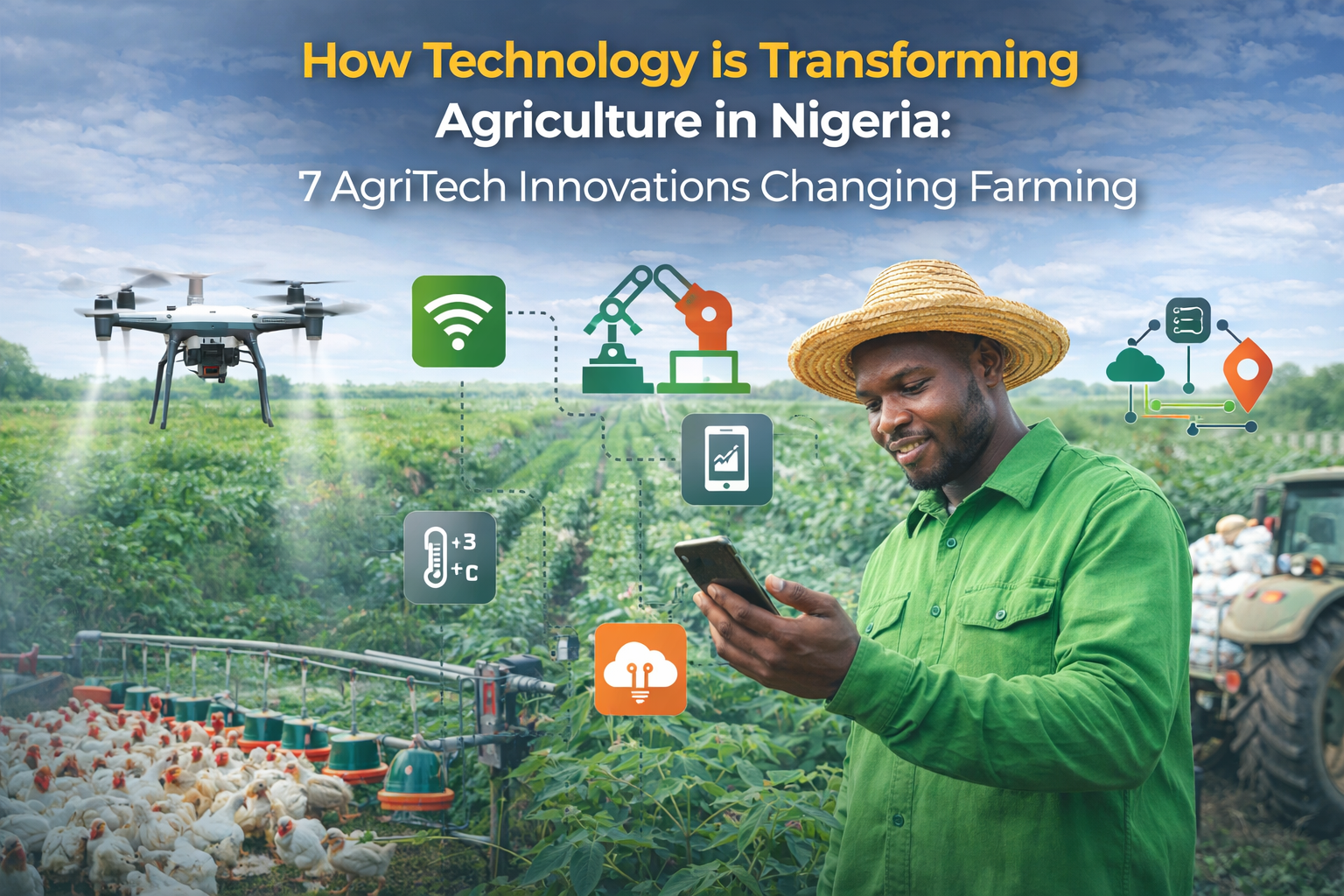
Nigerian agriculture has historically been characterised by low input use, manual labour, limited market access, and high post-harvest losses. For decades, the sector's productivity lagged behind its enormous potential — not because the land was poor or the farmers were unwilling, but because the tools, information, and systems needed to farm more efficiently simply were not accessible to the majority of Nigerian producers.
That is changing rapidly. Agricultural technology — agritech — is now penetrating Nigeria's farming sector at a pace that would have been difficult to imagine a decade ago. From AI-powered yield forecasting and satellite farm monitoring to digital marketplaces and e-wallet input distribution systems, technology is reshaping every segment of Nigeria's agricultural value chain.
This article covers seven of the most impactful agritech innovations currently transforming agriculture in Nigeria, what each one does, and how Ifarmers Agricultural Products Services Limited is actively implementing several of these technologies through its operations and platforms.
1. AI-Powered Yield Forecasting
Artificial intelligence is being applied to one of farming's oldest challenges — predicting how much a crop will produce before it is harvested. Traditionally, yield estimates were based on farmer intuition, visual inspection, and historical averages. These methods are imprecise and often wrong, making it difficult for farmers to plan sales, for investors to project returns, and for buyers to plan procurement.
AI-powered yield forecasting changes this by analysing multiple data streams simultaneously:
- Current crop growth stage and canopy health data captured via satellite imagery
- Historical yield data from the same or similar farm locations across previous seasons
- Current and forecast weather data including rainfall, temperature, and solar radiation
- Soil moisture and nutrient availability estimates
The AI model synthesises these inputs to produce a yield estimate that is significantly more accurate than traditional methods — and crucially, it produces this estimate weeks before harvest, giving farmers, investors, and buyers the lead time to make better decisions.
Ifarmers implements AI-powered yield forecasting through the Agrolinkr AI module, giving investors on the FarmInvest platform visibility into projected returns before harvest season.
2. Satellite Farm Monitoring
Satellite technology has transformed the ability to monitor large farming operations remotely. Where farm monitoring previously required physical field visits — costly, time-consuming, and limited in frequency — satellite imagery now provides continuous, objective data on farm conditions from orbit.
Modern agricultural satellite monitoring systems capture multispectral images of farmland — images that see beyond the visible spectrum to reveal information the human eye cannot detect:
- NDVI (Normalised Difference Vegetation Index) — A measure of crop greenness and photosynthetic activity that reveals whether crops are healthy, stressed, or declining across a field
- Soil moisture mapping — Identifying areas of the farm that are too wet or too dry, enabling targeted irrigation or drainage decisions
- Pest and disease early detection — Subtle changes in crop reflectance that precede visible symptoms of pest infestation or disease outbreak, allowing intervention before damage becomes severe
- Flood and drought damage assessment — Rapid mapping of field areas affected by weather events, supporting insurance claims and recovery planning
For investors in agricultural projects, satellite monitoring is a game-changer for transparency and trust. Rather than relying on periodic updates from a farm manager, investors can access satellite images of their farming project at any time and verify that the farm is being managed as represented.
Ifarmers uses satellite monitoring through the Agrolinkr AI platform to provide remote farm visibility to investors and farm managers across its operational portfolio.
3. E-Wallet and Digital Input Distribution Systems
One of the most transformative agritech applications in Nigeria has been the introduction of digital wallet and voucher systems for agricultural input distribution. Traditional input subsidy programmes — where government distributes physical bags of fertilizer through administrative channels — are plagued by diversion, delays, and corruption. Digital systems significantly reduce these problems.
Under e-wallet input distribution models:
- Registered farmers receive a digital voucher or credit on their mobile phone linked to their BVN and farmer registration profile
- The voucher is redeemable at approved input suppliers for fertilizer, seeds, or agrochemicals
- The redemption is recorded digitally in real time, creating an auditable transaction trail
- Farmers have more flexibility in choosing when and where to redeem their input credit within the programme window
The impact on accountability is substantial. Digital systems make it far more difficult to claim that inputs were distributed to farmers who never received them. Every transaction is timestamped, geolocated, and linked to a verified farmer identity.
Beyond government programmes, private input suppliers are also leveraging digital ordering and payment systems to reach farmers who previously had to travel long distances to purchase inputs — reducing friction and improving input access for rural farmers.
4. Digital Agricultural Marketplaces
Market access is one of the most persistent challenges for Nigerian farmers. Without connections to buyers beyond their immediate local market, farmers are price-takers — forced to accept whatever the local middleman offers, often at a fraction of what their produce would fetch in a wider market.
Digital agricultural marketplaces solve this by creating a structured platform where farmers and commodity sellers can list their produce and connect directly with buyers — food manufacturers, exporters, processors, and institutional purchasers — who would otherwise be inaccessible.
The benefits of digital marketplace access for Nigerian farmers include:
- Exposure to a much larger pool of buyers, creating competitive pricing rather than monopolistic local pricing
- Quality documentation built into the transaction process, helping farmers understand and meet buyer standards
- Reduced dependence on informal middlemen who capture disproportionate margins
- Faster payment cycles through digital transaction processing compared to informal cash-based arrangements
Agrolinker's marketplace module, developed by Ifarmers, directly addresses this gap in Nigeria — connecting verified commodity sellers with domestic and export buyers through a structured digital platform.
5. Drone Technology for Crop Spraying and Field Mapping
Agricultural drones are increasingly being deployed in Nigeria for two primary applications: precision crop spraying and aerial field mapping.
Drone spraying involves using unmanned aerial vehicles (UAVs) equipped with spray systems to apply agrochemicals — herbicides, insecticides, fungicides — to crops from above. Compared to manual or tractor-based spraying, drone spraying offers:
- More uniform application coverage, including over crop canopies that manual sprayers cannot penetrate effectively
- Significantly faster coverage — a drone can spray several hectares per hour compared to a few hectares per day for a manual sprayer
- Reduced chemical use through precision targeting — applying only where needed rather than broadcasting across the entire field
- Reduced human chemical exposure — operators control the drone from a safe distance rather than walking through freshly sprayed fields
Aerial field mapping using drones generates high-resolution farm maps that support precision agriculture decisions — identifying drainage problems, soil variation zones, areas of uneven crop establishment, and boundary delineation for large farms.
Drone adoption in Nigeria is still growing, with cost being the primary barrier for smallholder farmers. However, drone-as-a-service models — where farmers pay per hectare for drone spraying rather than owning equipment — are making this technology progressively more accessible.
6. Soil Sensor Networks and Precision Fertilisation
Soil sensor technology places networked sensors in agricultural fields to continuously monitor key soil parameters in real time — moisture levels, temperature, electrical conductivity (a proxy for nutrient concentration), and pH — and transmit this data wirelessly to a farm management dashboard.
For Nigerian farmers and agribusiness operators, the practical applications are significant:
- Real-time soil moisture monitoring enables irrigation scheduling decisions based on actual soil conditions rather than calendar-based assumptions, reducing water waste and improving crop performance
- Nutrient monitoring data informs fertiliser application decisions — applying fertiliser when and where the soil actually needs it rather than on a fixed schedule
- Early detection of soil pH changes allows corrective action before productivity is significantly affected
- Sensor data collected over multiple seasons builds a detailed soil health database that improves agronomic decision-making progressively
When combined with AI analytics and custom fertiliser blending — which Ifarmers provides through its blending partnerships — soil sensor data creates a closed-loop precision nutrition system that consistently outperforms generic input programmes.
7. Blockchain for Agricultural Supply Chain Transparency
Blockchain technology is beginning to be applied in Nigerian agriculture to address one of the sector's most persistent problems — the inability to verify the origin, quality, and handling history of agricultural commodities as they move through the supply chain.
In a blockchain-enabled agricultural supply chain:
- Key events in the commodity's journey — planting date, harvest date, inspection results, processing steps, warehouse entries, and shipment milestones — are recorded as immutable entries on a distributed digital ledger
- Every participant in the chain — farmer, aggregator, processor, exporter, buyer — can access the full transaction history of a specific lot of commodity
- Quality certificates and inspection results are linked directly to the commodity record, making verification instantaneous and tamper-proof
- Export buyers in the EU, USA, and Asia can trace the exact origin of the commodity they are purchasing, supporting food safety compliance and premium market access
For Nigerian agro-exporters, blockchain traceability is becoming increasingly relevant as international markets tighten their food safety and sustainability requirements. Exporters who can provide verified, tamper-proof origin and handling documentation are better positioned to access premium-paying buyers who are willing to pay above-market prices for transparently sourced commodities.
The Challenges Slowing AgriTech Adoption in Nigeria
Despite the momentum, several structural challenges continue to slow agritech adoption across Nigeria's agricultural sector:
- Limited rural internet connectivity — Many of the farmers who would benefit most from agritech tools live and work in areas with poor or no mobile internet access, limiting the reach of data-dependent applications
- Digital literacy gaps — A significant proportion of Nigerian smallholder farmers — particularly older farmers and women farmers in rural areas — lack the digital skills to use smartphone-based agricultural applications independently
- Affordability barriers — Many agritech tools require hardware investment (sensors, drones, smartphones) or subscription fees that are out of reach for smallholder farmers without subsidised access
- Trust and adoption resistance — Farmers who have been sold ineffective products by unscrupulous operators are understandably cautious about new technologies. Building trust requires demonstrating results on the ground, not just promising them on a platform
- Infrastructure dependencies — Reliable power supply and physical road access are prerequisites for many agritech applications. These foundational infrastructure gaps remain significant in rural Nigeria
Addressing these challenges requires a combination of government investment in rural infrastructure, development partner support for agritech access programmes, and private sector innovation in low-cost, offline-capable agricultural technology solutions.
How Ifarmers Is Implementing AgriTech in Nigeria
Ifarmers Agricultural Products Services Limited is not simply an observer of Nigeria's agritech evolution — it is an active implementer. Through its agritech initiatives, Ifarmers has layered technology on top of its core agro-commodity export and input supply operations to create integrated digital agriculture services:
- The Agrolinkr AI platform provides satellite farm monitoring, yield forecasting, and weather risk management for farming projects and investor portfolios
- The FarmInvest module enables crowdfunded agricultural investment with real-time farm visibility for investors
- The Agrolinker marketplace connects Nigerian commodity sellers with domestic and export buyers through a structured digital platform
- FarmForMe delivers managed farming services backed by AI monitoring and professional agronomic management
Ifarmers' Software Development Unit continues to build and refine these technology capabilities — making us one of a small number of Nigerian agribusinesses that combines operational agricultural expertise with genuine in-house technology development capability.
Frequently Asked Questions
Is agritech in Nigeria only relevant for large commercial farms? No. While some agritech tools — particularly those requiring significant hardware investment — are currently more accessible to large-scale operators, many digital agriculture applications are specifically designed to serve smallholder farmers. Digital marketplaces, e-wallet input systems, and mobile advisory tools are all designed to reach smallholder farmers at scale. The direction of agritech development in Nigeria is increasingly towards tools that are accessible on basic smartphones and usable with limited internet connectivity.
How can an investor use agritech to reduce risk in agricultural investments? Agritech reduces agricultural investment risk in several ways. Satellite monitoring gives investors independent verification of farm activity rather than relying solely on operator reports. AI yield forecasting provides earlier and more accurate harvest projections. Weather risk tools provide advance warning of climate events. And blockchain traceability reduces counterparty risk in commodity transactions by creating verifiable records at every stage. Together, these tools make agricultural investment significantly more transparent and manageable than traditional arrangements.
What does Ifarmers' agritech platform offer that other platforms do not? The key differentiator is that Ifarmers' agritech platform is built on a foundation of real agricultural operations — over 7 years of agro-commodity export, input supply, and project management experience across multiple Nigerian states. The technology serves real farming activities that Ifarmers manages and oversees operationally. This is fundamentally different from technology platforms built without deep agricultural operations knowledge, where the farming activities behind the investment interface may not be as robustly managed or verified.
Nigerian Agriculture's Digital Future Is Already Here
The transformation of Nigerian agriculture through technology is not a future event — it is happening now, across every segment of the value chain. Farmers, investors, buyers, and agribusinesses that engage with these tools today will have a significant competitive advantage over those who wait.
Want to explore how agritech can improve your farming operations or agricultural investments in Nigeria? Contact Ifarmers Agricultural Products Services Limited — one of Nigeria's leading agritech-enabled agribusinesses, based in Abuja, FCT.
📍 Amb. I. Osakwe House, Inner Block St, CBD, Abuja, FCT, Nigeria 🌐 www.ifarmerslimited.com