Nigeria has approximately 36 million smallholder farmers, and the vast majority of them farm on less than two hectares. These farmers collectively produce the bulk of Nigeria's domestic food supply — yet they remain chronically underserved when it comes to access to quality agricultural inputs. Fertilizer, improved seeds, and agrochemicals that could significantly improve their yields are either unavailable in their communities, available only in substandard form, or priced beyond what their margins can support.
This is not primarily a supply problem. Nigeria produces and imports sufficient quantities of fertilizer and other inputs each year. It is a distribution problem — specifically, a last-mile distribution problem. Getting inputs from manufacturers, importers, and government warehouses into the hands of smallholder farmers at the right time, in the right quantity, and at the right quality is where the agricultural input supply chain in Nigeria consistently breaks down.
This article explains how professional agro input distribution works, what the key challenges are, and how Ifarmers Agricultural Products Services Limited has built a distribution model capable of reaching farmers at scale.
What Is Agro Input Distribution and Why Does It Matter?
Agro input distribution refers to the full supply chain process of moving agricultural inputs — fertilizer, seeds, agrochemicals, and related materials — from their point of manufacture or importation through to the end user: the farmer in the field.
The distribution chain typically involves several layers:
- Manufacturers and importers — Companies that produce or bring fertilizer, seeds, and agrochemicals into Nigeria
- Bulk suppliers — Businesses that purchase from manufacturers and importers in large volumes and hold inventory for onward distribution
- Programme implementers — Organisations contracted by government agencies or development partners to manage input distribution to defined beneficiary groups
- Last-mile delivery agents — Field-level personnel, logistics teams, and local distribution points that physically move inputs from central warehouses to farmers in rural communities
Each layer in this chain adds complexity, cost, and potential for failure. Professional input distribution management is about compressing and controlling as many of these layers as possible to ensure quality, accountability, and timeliness from source to farmer.
The stakes are high. A farmer who receives fertilizer two weeks after the optimal application window has passed has effectively received no fertilizer at all in terms of that season's yield outcome. A farmer who receives adulterated inputs has not only wasted money but may have also suffered crop damage. Getting input distribution right is not an operational nicety — it is a direct determinant of agricultural productivity.
The Last-Mile Challenge in Nigerian Agriculture
Last-mile delivery is the most difficult, expensive, and failure-prone segment of the agricultural input supply chain in Nigeria. Several structural factors make it particularly challenging:
- Poor rural road infrastructure — Many farming communities in Nigeria are accessible only by unpaved roads that become impassable during the rainy season, which often coincides with the peak input distribution period. Logistics planning must account for seasonal road conditions, not just distance.
- Dispersed and fragmented beneficiary populations — Smallholder farmers are spread across thousands of communities in multiple states, often without formal addressing systems. Identifying, verifying, and physically reaching every beneficiary requires significant field presence and local knowledge.
- Limited local storage capacity — Many rural communities lack adequate warehousing facilities, meaning inputs stored at community level are exposed to moisture, theft, and deterioration if distribution is delayed after delivery.
- Fake and substandard inputs in local markets — Counterfeit fertilizer, adulterated agrochemicals, and low-germination seeds are a pervasive problem in Nigerian input markets, particularly at the last mile where quality oversight is weakest. Farmers who cannot distinguish genuine from fake inputs are highly vulnerable.
- Seasonal timing pressure — Input distribution must align precisely with the farming calendar. The window between when a farmer needs inputs and when those inputs stop being useful agronomically is often very narrow — sometimes just two to four weeks.
- Documentation and accountability gaps — Many last-mile distribution operations in Nigeria are poorly documented, making it impossible to verify whether inputs reached the intended farmers or were diverted along the way.
Key Elements of a Professional Input Distribution Model
Organisations and agencies that consistently deliver agro inputs to farmers at scale share several common operational characteristics:
Verified Beneficiary Management:
- Beneficiary lists are compiled and verified before any distribution begins — cross-referenced against registration data, cooperative membership records, or LGA farmer databases
- Each beneficiary is assigned a unique identifier and their allocation is documented against that identifier
- Distribution points are organised to manage specific groups of farmers rather than open queues, reducing the risk of double-collection and improving accountability
Structured Logistics:
- A central warehouse receives and holds the full input consignment before distribution begins
- Secondary distribution points closer to farming communities are identified and prepared in advance
- Vehicles and transport are pre-contracted with routes and delivery schedules defined before the distribution window opens
- A Warehouse Manager and Logistics Coordinator oversee movement documentation at every stage
Quality Verification at Receipt:
- All inputs are inspected upon arrival at the central warehouse before being signed into inventory — checking packaging integrity, lot numbers, expiry dates, and product labelling
- Suspect or damaged inputs are quarantined and reported to the procuring organisation before distribution proceeds
- Random sample testing of fertilizer or seed lots provides an additional quality assurance layer for large programmes
Field Supervision:
- Field Supervisors are deployed at active distribution points to oversee the process, manage community dynamics, and document what is happening on the ground
- Signed farmer receipt forms are collected at every distribution point — creating a physical audit trail that can be verified against the planned beneficiary list
- Photographic and video documentation of distribution activities provides visual evidence of delivery for reporting purposes
Community Engagement:
- Farmers are informed in advance about when and where distribution will take place through community leaders, cooperative heads, and local government extension officers
- Clear communication about what inputs are being distributed, in what quantities, and on what basis reduces confusion and community tension during distribution
- A feedback and complaints mechanism allows farmers to report problems — wrong inputs, short quantities, damaged packaging — to the implementing organisation directly
How Ifarmers Distributes Agro Inputs Across Nigeria
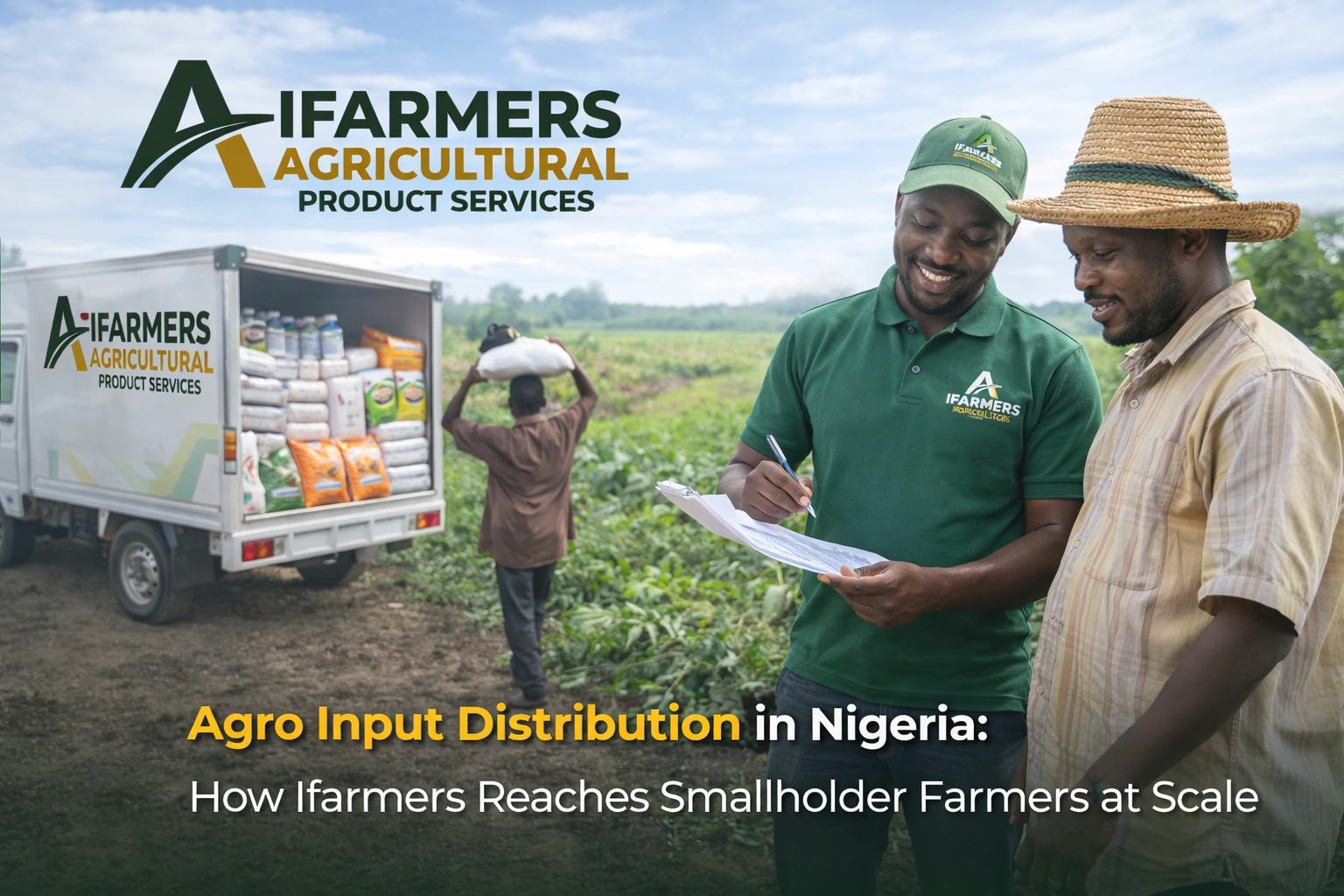
Ifarmers Agricultural Products Services Limited has a dedicated Agro Input Supply and Distribution Unit that has executed input distribution programmes across multiple Nigerian states, reaching thousands of smallholder farmers through government-funded and development partner programmes.
Our distribution track record spans states including Ekiti, Ogun, Abia, and Imo, where we have successfully delivered fertilizer, agrochemicals, and related inputs to verified farmer beneficiaries under structured procurement and distribution mandates.
Our distribution model is built around a structured team:
- Procurement Officers who source quality-verified inputs from approved suppliers and manage the inbound supply chain
- Warehouse Manager who oversees receipt, storage, and outbound movement of all input inventory with full documentation
- Logistics Coordinators who plan and manage vehicle routing, delivery scheduling, and secondary distribution point operations
- Field Supervisors deployed at distribution points in target states to oversee on-the-ground delivery and collect signed beneficiary receipts
- Sales Representatives who maintain relationships with cooperative leaders, LGA agriculture offices, and community contacts in target areas
- Community Engagement Officers who communicate programme details to beneficiary communities, manage expectations, and collect farmer feedback
This structure ensures that every element of the distribution chain — from procurement to final farmer receipt — has a designated responsible person and a documentation trail.
The Importance of Quality Control in Input Distribution
One of the most critical — and often overlooked — elements of agro input distribution is quality verification. Distributing fake or substandard inputs is in many ways worse than distributing nothing at all. Farmers apply the inputs in good faith, see no agronomic response, conclude that fertilizer or improved seeds "don't work," and revert to traditional low-input farming practices that perpetuate low yields.
Ifarmers implements quality control measures at multiple points in the distribution chain:
- All fertilizer consignments are sourced from verified, reputable suppliers — Ifarmers partners with Greenwell Fertilizer, Matrix Fertilizer, and United Fertilizer, whose products have established quality track records
- Inputs are inspected at the point of receipt into our warehouse, with any non-conforming products quarantined before distribution
- Lot numbers and manufacturing details are documented for every consignment, enabling traceability if quality issues are identified post-distribution
- Field Supervisors are trained to identify and flag suspect inputs at distribution points
This approach protects farmers, protects the programme's credibility, and protects the investing organisation's resources from being wasted on inputs that deliver no agronomic benefit.
Who Commissions Agro Input Distribution Services?
Professional agro input distribution services are relevant for a range of organisations operating in Nigeria's agricultural sector:
- Federal and state government agencies — Ministries of agriculture, ADPs, and programme management units that need a credible, experienced implementing partner to handle last-mile delivery of inputs procured under government programmes
- International development organisations — Bodies such as USAID, IFAD, the World Bank, and the Bill & Melinda Gates Foundation that fund agricultural input access programmes and require a Nigerian implementing partner with documented distribution capability
- NGOs working in food security — Both local and international NGOs running agricultural livelihoods programmes that include input provision as a component
- Agribusinesses with contract farming arrangements — Private sector companies supplying inputs to contract farmers as part of an outgrower scheme who need a logistics and distribution partner in specific states
- Large cooperative federations — Apex cooperatives representing thousands of farmer members who want to procure inputs in bulk and distribute to member cooperatives in multiple locations
Frequently Asked Questions
How does Ifarmers ensure that inputs reach the correct farmers and are not diverted? Ifarmers uses a multi-layer accountability system. Beneficiary lists are verified before distribution begins. Every farmer recipient signs a receipt form at the point of collection. Field Supervisors are present at distribution points and do not permit distribution to proceed without proper documentation. Photographic evidence is collected throughout. This chain-of-custody documentation means that every bag of input distributed can be traced from our warehouse to a named farmer beneficiary.
Can Ifarmers handle distribution in states where it has not previously operated? Yes. While our track record is deepest in the states where we have completed previous programmes, our distribution model is designed to be replicable across Nigeria. We conduct advance logistics assessments in new programme areas, establish local distribution point contacts, and deploy field personnel from our team. New state operations require adequate lead time for planning — we recommend engaging us at least 6 to 8 weeks before the planned distribution window.
What types of inputs does Ifarmers distribute? Ifarmers distributes the full range of common agricultural inputs including NPK fertilizers (15:15:15, 20:10:10, and custom blends), Urea, Single Super Phosphate (SSP), improved crop seeds, herbicides, insecticides, and fungicides. The specific input mix for any programme is determined by the commissioning organisation's procurement and the agronomic requirements of the target crop and geography.
How are distribution timelines managed to align with the farming calendar? We build every distribution plan backwards from the agronomically critical input application dates for the target crop and region. Procurement, logistics contracting, warehouse setup, beneficiary communication, and field team deployment are all scheduled against these agronomic deadlines. We flag early when any element of the plan is at risk of causing a timeline slip and work with the commissioning organisation to resolve it before the planting window is compromised.
Partner With Ifarmers for Your Input Distribution Programme
Getting quality agricultural inputs to smallholder farmers at the right time and in the right quantity is one of the most impactful investments in Nigerian agricultural productivity. It is also one of the most operationally complex. The difference between a distribution programme that delivers measurable yield improvement and one that wastes resources on late, diverted, or substandard inputs is the quality of the implementing partner.
Looking for a credible, experienced agro input distribution partner in Nigeria? Ifarmers Agricultural Products Services Limited has the field presence, the documentation systems, the supplier relationships, and the track record to deliver your programme to the standard your beneficiaries and funders expect.
📍 Amb. I. Osakwe House, Inner Block St, CBD, Abuja, FCT, Nigeria 🌐 www.ifarmerslimited.com