For most of Nigeria's agricultural history, knowing what was happening on a farm meant physically being on that farm. A farmer who could not visit a distant field for two weeks simply did not know whether the crop was healthy, whether pests had arrived, whether the soil was too dry, or whether a section of the field had been flooded. Farm managers working across large operations faced the same problem at scale — there was simply no way to monitor everything without being everywhere at once.
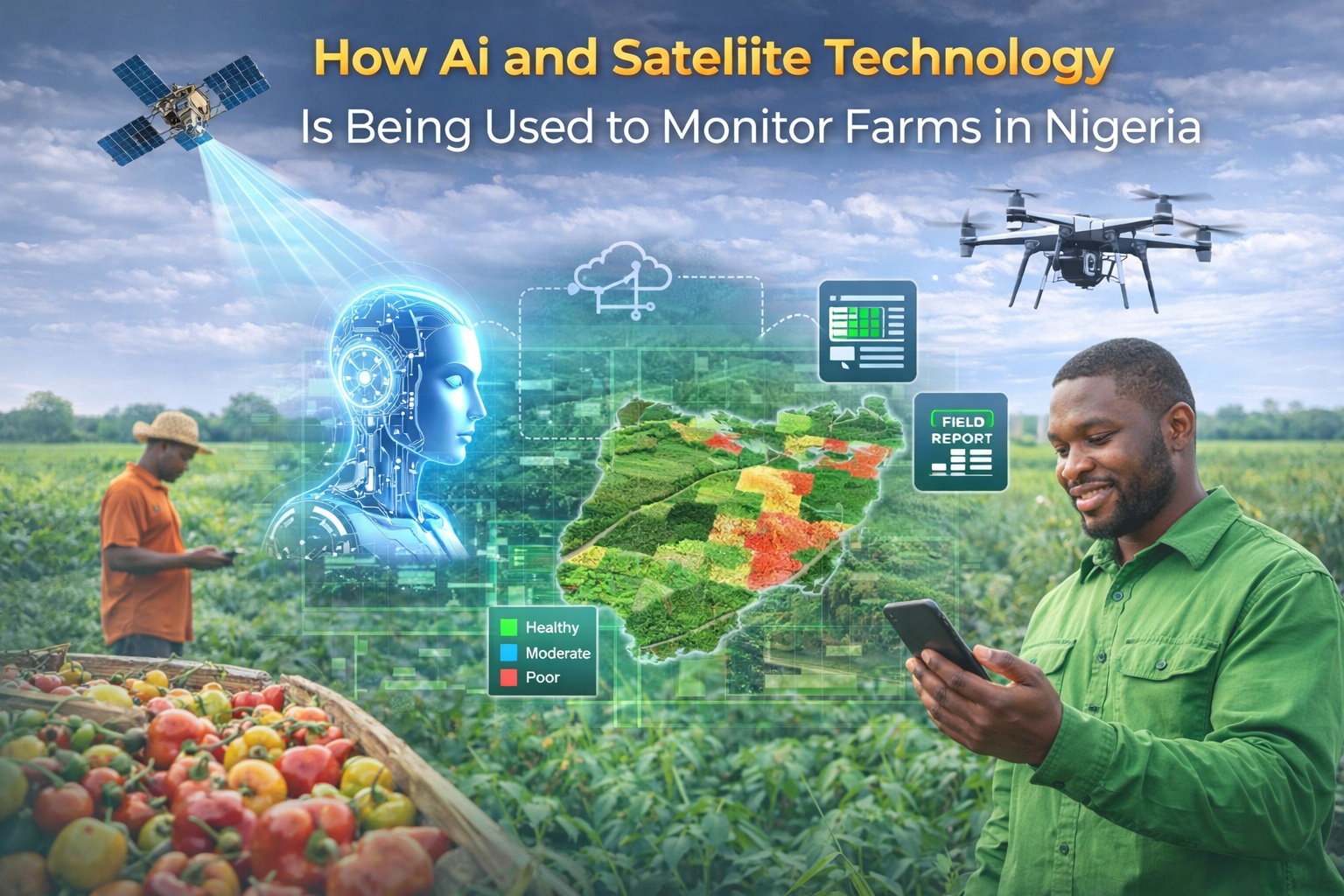
Satellite technology and artificial intelligence have fundamentally changed this reality. Today, it is possible to monitor the health of a farm in Kaduna from a laptop in Lagos, detect the early signs of fall armyworm infestation in a Benue maize field before visible damage appears, forecast the harvest yield of a sesame farm in Jigawa weeks before the crop is ready, and identify which specific sections of a rice field are waterlogged and need drainage intervention — all without setting foot on the farm.
This article explains how AI and satellite farm monitoring works, what specific problems it solves for Nigerian farmers and investors, and how Ifarmers Agricultural Products Services Limited is already implementing these technologies across its farming operations.
How Satellite Farm Monitoring Works
Agricultural satellites orbit the earth continuously, capturing images of the land surface below at regular intervals — in some cases daily, in others every few days depending on the satellite system. Unlike ordinary photographs, agricultural satellites capture images across multiple bands of the electromagnetic spectrum simultaneously, including infrared and near-infrared wavelengths that are invisible to the human eye but extremely revealing about crop and soil conditions.
The process from satellite image to farm insight works as follows:
- A satellite passes over the target farm area and captures a multispectral image of the land surface
- The image data is transmitted to ground processing systems where it is corrected for atmospheric interference and calibrated to produce accurate reflectance values
- Vegetation indices and other analytical layers are computed from the multispectral data — translating raw image values into meaningful indicators of crop health, soil moisture, and field conditions
- AI models are applied to these processed indices to generate interpretable insights — is this crop healthy or stressed? Is this section of the field producing normally or underperforming? Is there evidence of pest activity or disease?
- These insights are delivered to the farmer, farm manager, or investor through a dashboard or mobile application in a format that supports practical decision-making
The entire process from satellite capture to actionable farm insight can happen within 24 to 48 hours — fast enough to support timely intervention when problems are detected.
Key AI and Satellite Applications in Nigerian Farm Monitoring
1. NDVI Crop Health Monitoring
The Normalised Difference Vegetation Index (NDVI) is the most widely used satellite-derived indicator in precision agriculture. It measures the density and health of vegetation across a field by comparing how much red versus near-infrared light the crop canopy reflects.
- Healthy, actively growing crops absorb red light for photosynthesis and strongly reflect near-infrared light — producing high NDVI values
- Stressed, diseased, or sparse crops absorb less red light and reflect less near-infrared — producing lower NDVI values
- NDVI maps of a farm reveal spatial variation in crop performance — healthy zones shown in deep green, stressed or underperforming zones flagged in yellow or red
- Regular NDVI monitoring across a growing season tracks whether the crop is progressing normally or whether specific zones require intervention
For Nigerian farmers managing large fields, NDVI monitoring identifies problem areas that a ground-level walk might miss entirely — particularly in dense-canopy crops like maize or rice where early stress may not be visible from the field boundary.
2. Early Pest and Disease Detection
One of the most valuable applications of satellite AI monitoring in Nigeria is the early detection of pest infestations and disease outbreaks — specifically for high-impact threats like fall armyworm in maize, rice blast, and cassava mosaic virus.
- Satellite indices detect subtle changes in crop reflectance that precede visible symptoms by days to weeks — early stress signatures that appear before the human eye can observe damage
- AI models trained on historical pest and disease outbreak data can classify these early stress signatures as likely indicators of specific threats, prompting an alert to the farm manager
- The alert includes the location and approximate extent of the affected area within the field — allowing targeted ground inspection and intervention rather than blanket spraying across the entire farm
- Early intervention — before the pest or disease has spread across a significant portion of the crop — is dramatically cheaper and more effective than reactive spraying after visible damage has already occurred
In a country where fall armyworm alone has caused devastating losses to Nigerian maize farmers in recent seasons, early detection through AI satellite monitoring is not a luxury — it is an economically critical capability.
3. Soil Moisture and Irrigation Monitoring
Satellite-derived soil moisture indices reveal the water status of agricultural land across a field in near real time:
- Areas of the field with excessive moisture — caused by poor drainage, over-irrigation, or localised flooding — are identified and mapped, allowing drainage interventions before waterlogging causes root damage
- Areas with moisture deficit — too dry for optimal crop growth — are flagged for priority irrigation or mulching
- Temporal monitoring tracks how quickly soil moisture is changing after rainfall or irrigation events, indicating whether water is being retained effectively or draining too rapidly
- In Nigeria's rain-fed farming systems, soil moisture monitoring helps farmers make more informed decisions about supplementary irrigation and drainage management
4. Yield Forecasting
AI yield forecasting applies machine learning models to multiple data streams — satellite crop health indices, historical yield data, weather forecasts, and soil information — to generate harvest yield estimates weeks before the crop is ready:
- Estimates are generated at the field level, not just as a single farm-wide average — allowing identification of high-performing and low-performing zones within the same field
- Forecasts are updated as new satellite data and weather information becomes available, progressively refining the estimate as harvest approaches
- Farmers and farm managers use yield forecasts for advance marketing decisions — when to approach buyers, what price to accept, how much storage capacity to arrange
- Investors use yield forecasts to project returns before harvest, improving financial planning and reducing the uncertainty that has historically made agricultural investment less predictable
5. Flood and Drought Damage Assessment
Nigeria experiences regular climate-related agricultural losses — both seasonal flooding in river basin farming areas and drought stress in the Sahel north. Satellite monitoring enables rapid damage assessment after these events:
- Post-event satellite imagery is compared against pre-event baseline images to map the extent of affected cropland accurately
- Damage severity is classified by zone — total loss, partial damage, or unaffected — providing the detailed information needed for insurance claims and recovery planning
- Assessment can cover thousands of hectares within days of the event, far faster than ground-based survey teams could achieve
- For government agencies and development partners responding to agricultural emergencies, satellite damage assessment provides the evidence base for targeting recovery resources effectively
How Ifarmers Uses AI and Satellite Technology
Ifarmers Agricultural Products Services Limited has integrated AI and satellite farm monitoring into its core agricultural operations — making it one of a small number of Nigerian agribusinesses deploying these technologies at an operational level rather than simply discussing them in concept.
Through its Software Development Unit and its Agrolinkr AI platform, Ifarmers provides:
- Remote farm monitoring for managed farming clients — Farms under Ifarmers' management are monitored continuously via satellite, with NDVI health tracking, soil moisture monitoring, and early stress detection built into the operational workflow
- Investor farm visibility — Investors who have committed capital to Ifarmers-managed farming projects receive satellite-based farm reports and yield forecasts through the platform, giving them independent verification of farm conditions without requiring physical site visits
- Yield forecasting for harvest planning — Satellite-derived yield estimates inform Ifarmers' commodity marketing decisions — when to approach buyers, what volumes to commit to, and how to time harvest logistics for optimal commodity value
- Weather risk management — Real-time weather monitoring and risk alerts are integrated into Ifarmers' farm management workflow, enabling proactive responses to approaching weather events that could affect crop performance
This is what differentiates Ifarmers from agricultural businesses that are simply talking about agritech — our technology is already working in the field, supporting real farming operations and providing real transparency to real investors.
The Cost Barrier and How It Is Being Reduced
Historically, satellite farm monitoring and AI analytics were prohibitively expensive for all but the largest commercial agricultural operations. Processing, storing, and analysing satellite imagery required significant technical infrastructure and expertise that small and medium agribusinesses could not justify economically.
Several developments are making this technology progressively more accessible:
- The proliferation of commercial earth observation satellites has dramatically increased image availability while reducing data costs — where imagery once cost hundreds of dollars per scene, cloud-based platforms now make satellite data available at a fraction of that cost
- Cloud computing infrastructure has removed the need for organisations to own and operate their own data processing hardware — AI analytics can now run on-demand at low marginal cost
- Open-source AI and machine learning tools have democratised the ability to build and deploy agricultural analytics models without starting from scratch
- Platform-as-a-service models — where an organisation like Ifarmers builds the monitoring infrastructure once and deploys it across multiple farms — spread the fixed technology cost across a larger operational base, reducing the per-farm cost significantly
The result is that satellite AI monitoring — once the preserve of large-scale commercial agriculture in developed countries — is now operationally viable for serious agribusinesses in Nigeria, and progressively becoming accessible to farmer cooperatives and smaller operations through service-based models.
What This Means for Agricultural Investment in Nigeria
For investors, the implications of AI and satellite farm monitoring are significant and direct:
- Transparency replaces trust — Investors no longer need to trust that a farm manager is reporting accurately because they can access independent satellite data that objectively reflects farm conditions. This fundamentally changes the risk profile of agricultural investment.
- Earlier problem detection protects returns — Early identification of crop stress, pest outbreaks, or weather damage allows remedial action before losses become unrecoverable. This improves the probability of investment returns surviving operational challenges.
- Yield forecasts reduce uncertainty — Knowing with reasonable confidence what a farm will produce several weeks before harvest allows investors to plan financial expectations and marketing logistics rather than being surprised at settlement.
- Accountability is built into the system — When farm conditions are continuously documented by satellite, it becomes much harder for unscrupulous operators to misrepresent farm activities or fabricate production outcomes. The satellite record is objective and tamper-proof.
Frequently Asked Questions
Do Nigerian farmers need a smartphone or computer to access satellite farm monitoring? Accessing the full satellite monitoring dashboard requires internet connectivity and a device capable of displaying map-based visualisations — typically a smartphone or computer. However, key alerts and farm status updates can be delivered via SMS to basic mobile phones for farmers in areas with limited internet access. The trend in agricultural technology is towards solutions that function on low-bandwidth connections and basic devices to maximise rural reach.
How accurate are AI yield forecasts for Nigerian crops? Accuracy depends on the quality of training data available for the specific crop and geography, the resolution of the satellite imagery used, and the sophistication of the AI model. In well-developed agricultural monitoring systems with sufficient historical data, yield forecasts can achieve accuracy within 10 to 15 percent of actual harvest yield — significantly better than unassisted visual estimation. Accuracy improves progressively as more seasonal data is collected from specific farm locations over successive years.
Can satellite monitoring detect fake or misrepresented farming activities? Yes, to a significant extent. Satellite imagery provides an objective, time-stamped record of what is happening on a piece of land — whether crops are actually planted, how they are growing, and when they are harvested. This makes it very difficult to claim farming activity that is not genuinely occurring. For investors evaluating agricultural investment platforms, asking whether the operator uses independent satellite monitoring is one of the most effective due diligence questions you can ask.
How often is satellite data updated for farm monitoring purposes? Update frequency depends on the satellite constellation being used. Some commercial satellite systems provide daily revisit capability for any location on earth. Others provide updates every 3 to 5 days. Cloud cover — which is frequent during Nigeria's rainy season — can interrupt optical satellite monitoring temporarily, though radar-based satellites can image through cloud cover. Effective farm monitoring systems use multiple satellite data sources to maintain continuity even during cloudy periods.
The Future of Nigerian Farming Is Already Visible From Space
AI and satellite technology are not coming to Nigerian agriculture — they are already here, already working, and already separating the agribusinesses that can provide genuine operational transparency from those that cannot.
For farmers, the technology means better decisions, earlier problem detection, and improved yields. For investors, it means unprecedented visibility into the assets they have funded. For the Nigerian agricultural sector as a whole, it means a progressive shift from subsistence-level information management to data-driven farming that can compete on the global stage.
Want to learn how Ifarmers is using AI and satellite technology to manage farms and protect investor returns in Nigeria? Contact Ifarmers Agricultural Products Services Limited — one of Nigeria's most technologically advanced agribusinesses, based in Abuja, FCT.
📍 Amb. I. Osakwe House, Inner Block St, CBD, Abuja, FCT, Nigeria 🌐 www.ifarmerslimited.com