
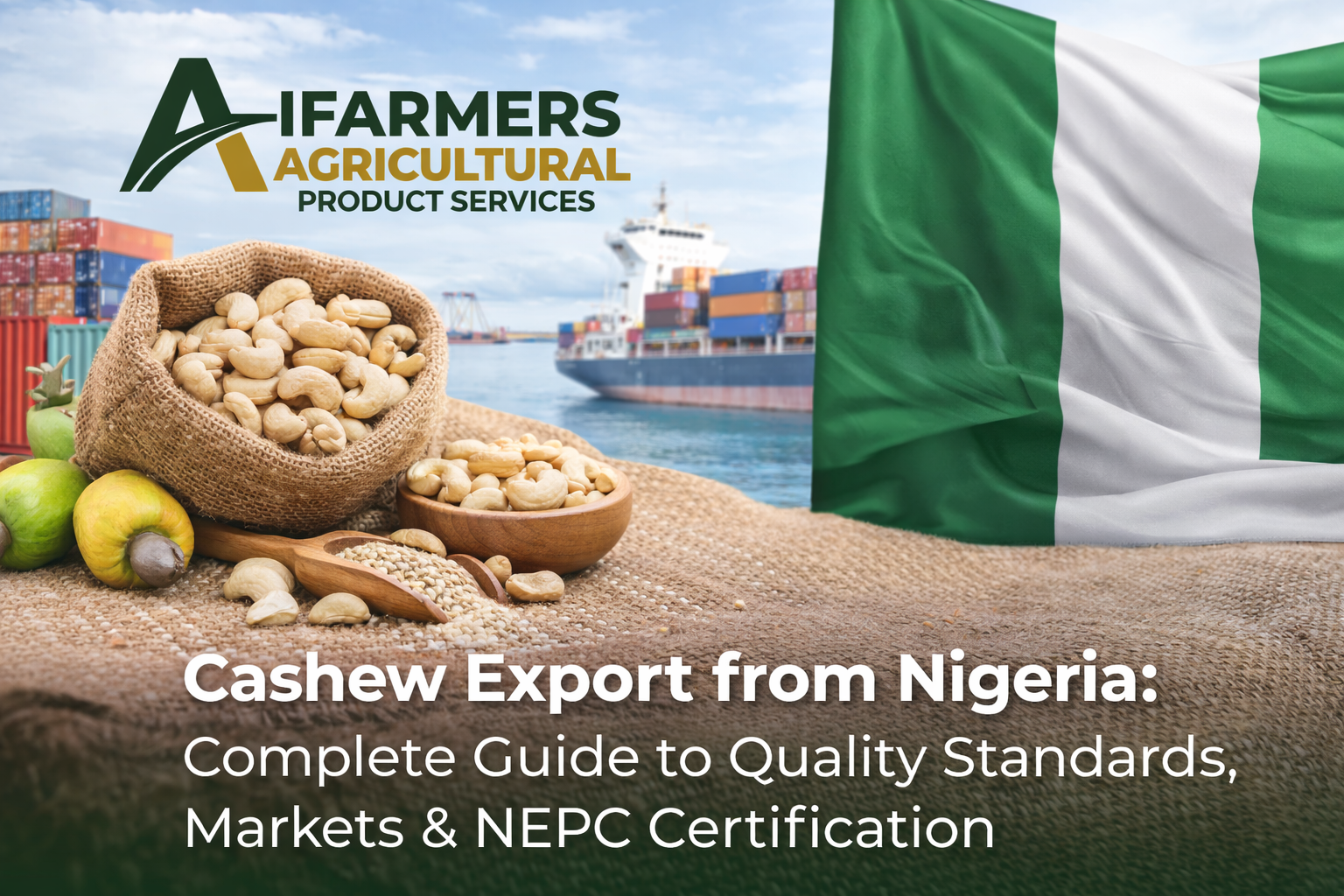
Nigeria is Africa's second-largest cashew producer, and the global appetite for cashew nuts continues to grow year after year. From snack manufacturers in Europe and North America to large-scale processors in India and Vietnam, international buyers are actively sourcing Nigerian cashew — and the opportunity for Nigerian exporters, farmers, and agribusinesses to profit from this demand is substantial.
However, cashew export is not as simple as bagging your nuts and finding a ship. There are quality standards to meet, certifications to obtain, documentation to complete, and buyer relationships to build. Get any of these wrong and your shipment could be rejected, your payment withheld, or your reputation as an exporter permanently damaged.
This guide covers everything you need to know about cashew export from Nigeria — the difference between raw and processed cashew, the quality requirements that determine your value, how to get NEPC certified, and where to find credible international buyers.
Nigeria's Position in the Global Cashew Market
Nigeria's cashew belt spans states including Kogi, Benue, Oyo, Kwara, Ondo, Enugu, and Cross River. The country produces a large volume of both Raw Cashew Nuts (RCN) and, increasingly, processed cashew kernels, which are sold at a significantly higher value.
Global demand for cashew has been driven by the snack food industry, the health food sector, dairy alternatives (cashew milk), and industrial uses such as Cashew Nut Shell Liquid (CNSL), which is used in brake linings, paints, and resins. This broad demand base means Nigerian cashew exporters have multiple market segments to target.
The two largest processing destinations for raw Nigerian cashew are India and Vietnam, which together account for a significant portion of global cashew processing capacity. However, exporters who invest in local processing and export cashew kernels rather than raw nuts can access European, North American, and Middle Eastern retail markets at considerably better value.
Raw Cashew Nuts vs. Processed Cashew Kernels: What You Need to Know
One of the most important decisions a Nigerian cashew exporter must make is whether to export Raw Cashew Nuts (RCN) or Processed Cashew Kernels. Both have different buyers, different requirements, and different value propositions.
Raw Cashew Nuts (RCN):
- Exported in their natural shell, directly after harvest and drying
- Primary buyers are large cashew processors in India and Vietnam
- Graded primarily by Kernel Outturn (KOR) — the weight of cashew kernels you get per 80kg bag of raw nuts
- Lower value per tonne compared to kernels, but simpler to process and export
- High volume, consistent demand from Asian processors throughout the harvest season (March to June)
Processed Cashew Kernels:
- Shelled, peeled, and graded cashew kernels ready for retail or further processing
- Graded by industry-standard classifications such as W180, W210, W240, W320, W450 (the number refers to kernel count per pound — lower numbers mean larger, more premium kernels)
- Access to higher-value markets: supermarkets and food manufacturers in Europe, the USA, and the Middle East
- Requires investment in processing equipment or a partnership with a local processing facility
- Significantly higher value per tonne, but more complex compliance requirements for destination markets
For most first-time exporters, starting with Raw Cashew Nuts is more practical. As your export experience and capital grow, transitioning into kernel exports opens access to premium markets.
Quality Standards for Cashew Export from Nigeria
Whether you are exporting raw or processed cashew, quality determines your price and your ability to retain buyers. Below are the key quality parameters you need to understand:
For Raw Cashew Nuts (RCN):
- Kernel Outturn (KOR) — This is the most important grading metric. A KOR of 48 and above is considered high quality and commands the best attention from processors. KOR below 44 will result in price deductions.
- Moisture content — Must be below 9% to prevent mould and deterioration during shipment. High moisture is one of the leading causes of cashew shipment rejection.
- Nut count — The number of nuts per kilogram. Buyers specify nut count alongside KOR, as larger nuts generally yield better kernels.
- Foreign matter — Cashew bags must be clean of stones, sand, damaged nuts, and other debris. Contaminated lots will be discounted heavily.
- Black and spotted nuts — Discoloured nuts signal poor handling or disease. Keep the proportion of defective nuts within internationally accepted limits.
For Processed Cashew Kernels:
- Kernels must be properly dried with low moisture content
- Graded uniformly by size class (W180 through W450 and splits/pieces)
- Packaged in vacuum-sealed, nitrogen-flushed tins or pouches to preserve freshness
- Free from insect infestation, mould, and off-flavours
- Must meet the food safety standards of your destination market (e.g., EU food safety regulations for European buyers)
How to Get NEPC Certified for Cashew Export
The Nigeria Export Promotion Council (NEPC) registration is a mandatory first step for any company looking to export cashew — or any other commodity — from Nigeria. It is your legal authorisation to operate as an exporter in the country.
The NEPC registration process involves submitting your company documents (CAC certificate, TIN, directors' information), a company profile, and completing the registration form through the NEPC portal. Once registered, you receive your exporter certificate and gain access to the Nigerian Export Proceed (NXP) form, which your bank requires before processing any export transaction.
Beyond NEPC, cashew exporters also need:
- A valid NAQS Phytosanitary Certificate for each shipment — confirming your cashew is free from pests and plant diseases
- A Federal Produce Inspection Certificate — verifying your commodity meets national quality and grading standards
- A Certificate of Origin — issued by the Nigerian Association of Chambers of Commerce, Industry, Mines and Agriculture (NACCIMA)
For those who find this process complex or time-consuming, Ifarmers Agricultural Products Services Limited handles the entire certification and documentation process on behalf of export clients. Contact us to find out how we can manage your cashew export from start to finish.
When to Engage Buyers: The Nigerian Cashew Season
Timing is critical in cashew export. The Nigerian cashew harvest season typically runs from March to June, with peak availability of Raw Cashew Nuts between April and May. This is the window when international buyers — especially processors in India and Vietnam — are most actively sourcing Nigerian cashew.
Here is what to do ahead of the season:
- Begin sourcing and aggregating cashew from farmers as early as February to ensure you have sufficient volume
- Confirm your NEPC registration and export documentation are current before March
- Reach out to buyers (or work through your export partner) at least 4–6 weeks before you are ready to ship
- Have your commodity graded and inspected before quoting quality specifications to buyers
- Arrange your logistics — freight forwarder, container booking, port handling — well in advance of the season peak
Post-season (July onwards), there is less RCN available, but processed kernel exporters can continue trading throughout the year from stored and processed inventory.
Where to Find International Cashew Buyers
Finding legitimate, paying buyers is where many Nigerian cashew exporters struggle. Here are the most effective channels:
- NEPC trade facilitation services — The NEPC connects registered Nigerian exporters with verified international buyers through trade missions, exhibitions, and its buyer database. Take full advantage of this as a registered exporter.
- International trade fairs — Events like the World Cashew Convention, Anuga (Germany), and SIAL (France) attract cashew buyers and processors from across the globe. Attending or exhibiting positions you directly in front of serious buyers.
- B2B trade platforms — Platforms such as Alibaba, TradeKey, and Europages have active listings for cashew buyers. A well-documented seller profile with certifications and product specifications significantly improves your response rate.
- Direct outreach to processors — Research and contact cashew processing companies in India (such as those in Kollam, Kerala) and Vietnam directly with your product specification sheet, certification documents, and sample availability.
- Partner with a certified export company — For farmers and traders without an established buyer network, working with a certified agro-exporter like Ifarmers provides immediate access to a network of pre-verified buyers across multiple markets.
Always insist on a formal purchase contract and use a Letter of Credit (LC) for first-time transactions with any buyer. Never release a shipment without confirmed, secure payment arrangements.
How Ifarmers Supports Your Cashew Export
Ifarmers Agricultural Products Services Limited is a NEPC and NAQS-certified agro-exporter based in Abuja, FCT, with over 7 years of experience exporting agricultural commodities including cashew from Nigeria.
Our Agricultural Products Export Unit includes a dedicated Export Coordinator and Documentation Specialist, meaning you have professional support at every stage of the export process. We provide:
- Commodity sourcing, aggregation, and quality grading
- Full export documentation and certification handling (NEPC, NAQS, Federal Produce Inspection)
- Buyer identification and transaction support
- Packaging, logistics, and shipment coordination
Whether you are a cashew farmer with produce ready to sell, a trader looking for a certified export partner, or an agribusiness seeking to enter the cashew export market, Ifarmers offers a turnkey solution.
Frequently Asked Questions
What is Kernel Outturn (KOR) and why does it matter? KOR refers to the weight of cashew kernels (in pounds) extracted from a standard 80kg bag of raw cashew nuts. A KOR of 48 means you get 48 pounds of kernels from one bag. The higher the KOR, the more valuable your raw cashew is to processors. Buyers use KOR as the primary quality and pricing metric for Raw Cashew Nuts, so knowing your KOR before quoting a price to buyers is essential.
What is the difference between W240 and W320 cashew kernels? These are grade classifications for processed cashew kernels. The number refers to how many whole kernels are present in one pound of cashew. W240 means 240 kernels per pound — these are larger, premium-grade kernels that command higher prices. W320 means 320 kernels per pound, which are slightly smaller but still high quality and the most widely traded grade globally. W180 is the most premium large-kernel grade, while higher numbers (W450) indicate smaller kernels sold at lower values.
Is NEPC registration mandatory for cashew export? Yes. NEPC registration is a legal requirement for any company exporting cashew or any other commodity from Nigeria. Without it, you cannot obtain the NXP form from your bank, which is required to process your export transaction. Attempting to export without proper registration risks seizure of your goods at the port.
Can I export cashew as an individual, or do I need a registered company? You need a registered business entity. While a Business Name registration with the CAC is technically sufficient to begin, a Limited Liability Company (LLC) structure is strongly recommended, particularly if you intend to access export grants, government incentives, open corporate bank accounts, or scale your operations. Most serious international buyers also prefer dealing with incorporated entities.
Begin Your Cashew Export Journey with Ifarmers
Cashew export from Nigeria is one of the most accessible and rewarding agro-commodity businesses when approached with the right knowledge, quality standards, and partners. Nigeria's production advantage is clear — what separates profitable exporters from those who struggle is preparation, compliance, and having the right support structure in place.
Ready to export cashew from Nigeria? Partner with Ifarmers Agricultural Products Services Limited — your NEPC and NAQS certified agro-export partner in Abuja, FCT, with over 7 years of proven export experience.
📍 Amb. I. Osakwe House, Inner Block St, CBD, Abuja, FCT, Nigeria 🌐 www.ifarmerslimited.com 📞 [Insert WhatsApp Number]
Written by Alderwood Management Limited on behalf of Ifarmers Agricultural Products Services Limited. Explore related articles: How to Export Ginger from Nigeria, Nigeria Sesame Seed Export Guide, and NEPC Certification Explained — all on the Ifarmers blog.