
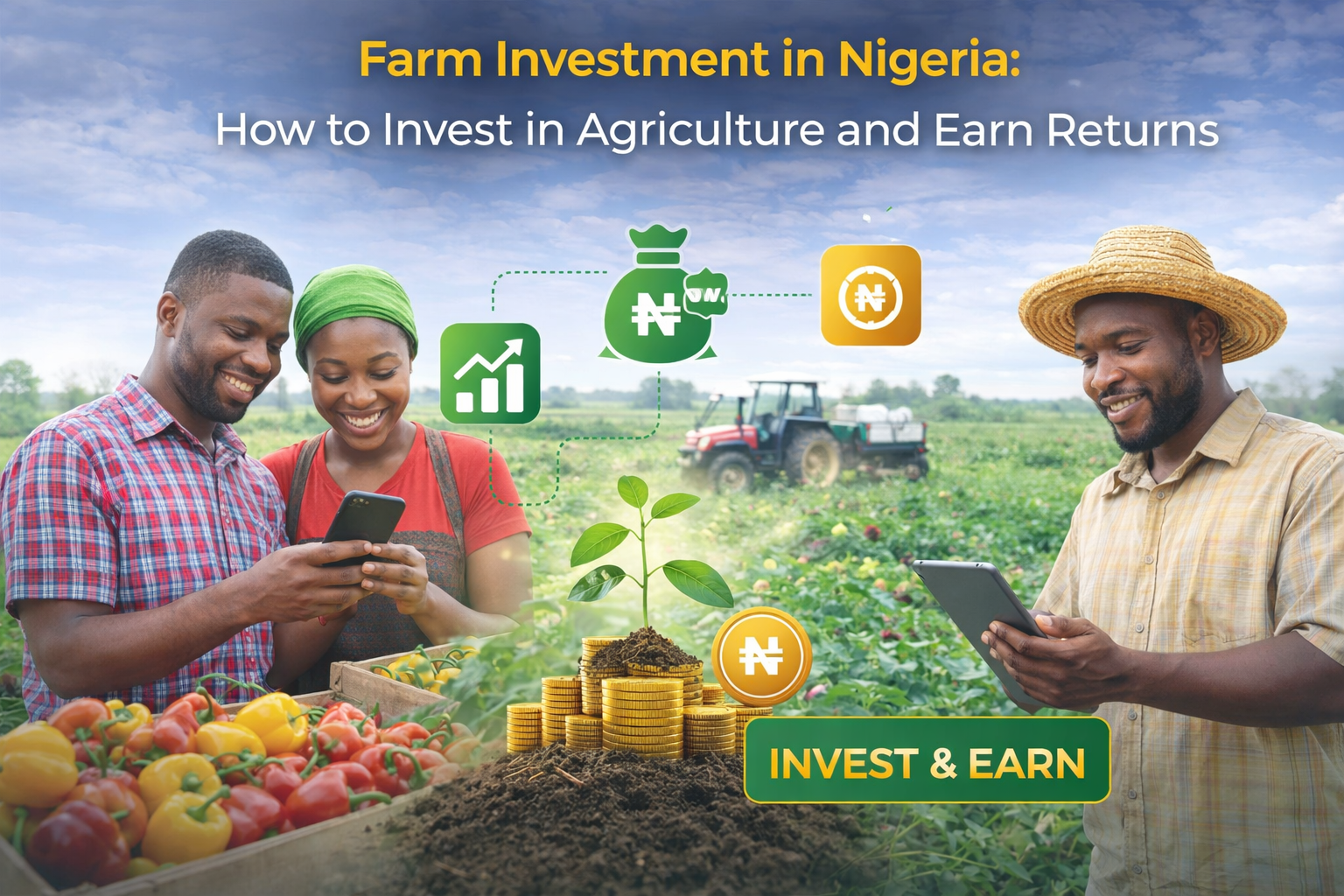
For years, Nigerians looking to grow their wealth beyond traditional financial instruments — fixed deposits, treasury bills, mutual funds — have known intuitively that agriculture offers strong return potential. Nigeria feeds over 220 million people. Demand for food grows every year. The land is there. The crops are there. The opportunity is obvious.
The problem has always been access. How does a professional in Lagos invest in a sesame farm in Kano without physically relocating? How does a Nigerian in the diaspora put money into a cashew operation in Kogi without knowing who to trust? How does any investor get visibility into what is happening on a farm they have funded without driving to a remote location every weekend?
These barriers kept agricultural investment largely inaccessible to ordinary Nigerian investors — and left a significant portion of Nigeria's farming potential chronically underfunded.
That is changing. New investment models, digital platforms, and professionally managed farming operations are making it possible for virtually anyone to invest in Nigerian agriculture and earn returns — without owning land, without farming expertise, and without leaving their city. This guide explains every legitimate model available, what realistic returns look like, and what to look for in a credible investment partner.
Why Agricultural Investment in Nigeria Makes Sense
Before exploring how to invest, it is worth understanding why agricultural investment in Nigeria is financially compelling:
- Consistent underlying demand — Food demand in Nigeria does not go away in a recession, a currency crisis, or a political transition. Population growth ensures that domestic food demand increases every year regardless of broader economic conditions.
- Naira-hedge commodity pricing — Many agricultural commodities — particularly export crops like sesame, cashew, ginger, and hibiscus — are priced in USD or international market equivalents. Investors who hold naira but earn returns linked to dollar-denominated commodity prices are partially protected against naira depreciation.
- Underinvestment creates opportunity — Nigeria's agricultural sector is significantly undercapitalised relative to its productive potential. This means that well-managed farming operations with proper inputs and professional oversight can generate returns that more saturated investment markets cannot.
- Diversification value — Agricultural returns have a low correlation with the Nigerian stock market, real estate cycles, and fixed income instruments. Adding agriculture to an investment portfolio improves overall risk-adjusted performance.
- Impact alongside return — Farm investment in Nigeria directly supports food security, rural employment, and smallholder farmer income — making it one of the few investment categories where financial return and social impact genuinely align.
Five Models for Investing in Nigerian Agriculture
1. Direct Land Purchase and Farming
The most traditional model — purchasing agricultural land and farming it directly, either personally or through hired farm managers.
- Offers full ownership and control of the agricultural asset
- Potential for both farming income and land value appreciation over time
- Requires significant capital for land acquisition, input procurement, and operational management
- Most appropriate for investors with substantial capital, strong agricultural knowledge, or reliable farm management partnerships
- Land acquisition in Nigeria requires careful due diligence on title documents — always engage a qualified lawyer to verify land ownership before any purchase
This model is the most capital-intensive entry point and carries the most operational complexity. It is not the starting point for most new agricultural investors.
2. Contract Farming
Contract farming involves a formal arrangement between an investor or agribusiness and a group of farmers, where the investor provides inputs and a guaranteed purchase price in exchange for the farmers growing a specified crop to agreed quality standards.
- Investors gain access to large volumes of produce without managing farm operations directly
- Farmers receive input support and income certainty they could not otherwise access
- The contractual structure protects both parties — though contract enforcement remains a practical challenge in many Nigerian agricultural settings
- Works best when implemented through an experienced agribusiness with established farmer relationships and field supervision capacity
- Returns are tied to commodity prices and crop performance — both of which are variable and require professional risk management
3. Cooperative and Group Farming Investment
Registered farming cooperatives pool capital and labour from multiple members to farm collectively, with profits distributed according to each member's contribution.
- Lower individual capital requirement compared to direct farming — members contribute what they can afford
- Risk is shared across the cooperative membership rather than concentrated in a single investor
- Cooperatives can access government support programmes, development partner funding, and Bank of Agriculture financing that individual farmers cannot
- Returns and governance quality vary enormously between cooperatives — membership in a well-managed cooperative with transparent accounts is very different from membership in a poorly run one
- Best suited for farmers and investors who want to be actively involved in the agricultural community rather than purely passive investors
4. Crowdfunded Farm Investment Platforms
Digital investment platforms allow individuals to invest in verified, professionally managed farming projects and earn returns at harvest — entirely online, without any farming involvement.
- Accessible to any investor with a smartphone and a bank account — no farming knowledge or land ownership required
- Investment amounts can be relatively modest, making agriculture accessible to first-time investors
- Professional farm management teams handle all operational aspects — input procurement, planting, crop management, harvest, and marketing
- Reputable platforms provide investors with regular farm updates, satellite monitoring access, and transparent reporting throughout the investment cycle
- Returns are typically distributed at harvest, with timelines varying by crop — shorter-cycle crops like maize or sesame (3 to 6 months) versus longer-cycle investments in tree crops (multiple seasons)
Agrolinker's FarmInvest module, developed by Ifarmers Agricultural Products Services Limited, operates on this model — connecting investors with verified farming projects managed by Ifarmers' professional team, with satellite monitoring through the Agrolinkr AI platform giving investors real-time farm visibility.
5. Tree Portfolio Investment
Tree crop investment involves purchasing ownership of productive trees — cashew, shea, oil palm, or other perennial crops — and earning income from the produce those trees generate across multiple harvest seasons.
- Long-cycle investment suited to patient capital — trees appreciate in productive value as they mature, and returns typically improve over successive seasons
- Creates a recurring income stream rather than a single-season return, reducing the reinvestment pressure of annual crop investments
- Tree ownership can be fractional — investors can own a defined number of trees rather than an entire farm, with returns proportional to their tree count
- Lower volatility than annual crop investments since the asset (the tree) persists across seasons regardless of any single year's weather or market conditions
- Agrolinker's TreeNaira module is specifically designed to facilitate tree crop investment in Nigeria — giving investors fractional tree ownership with professional management and harvest reporting
What Returns Can You Realistically Expect?
Agricultural investment returns in Nigeria are variable and depend on crop type, management quality, weather conditions, and commodity market prices. It is important to be realistic about both the upside and the risk.
As a general framework:
- Well-managed annual crop investments (sesame, maize, soya bean) in professionally operated programmes have historically generated gross returns in the range of 15 to 35 percent over the crop cycle, though these figures vary and past performance does not guarantee future returns
- Export commodity investments benefit from USD-linked pricing — when the naira depreciates, naira-denominated returns from commodities priced internationally can increase significantly
- Tree crop investments generate lower annual returns in early years but improve as trees mature, creating a long-term income asset rather than a series of single-season transactions
- Returns from poorly managed or fraudulent agricultural investment schemes in Nigeria can be zero or negative — the investment partner's credibility is the single most important variable in agricultural investment return outcomes
A useful comparison: at the time of writing, Nigerian government treasury bills offer returns in the range of 15 to 20 percent per annum. Well-managed agricultural investments with export commodity exposure can be competitive with or exceed this, while also providing naira-hedge benefits. But unlike treasury bills, agricultural investments carry operational risk that requires careful partner selection.
How to Identify a Credible Agricultural Investment Partner
The Nigerian investment landscape includes genuine, well-managed agricultural investment opportunities — and it also includes fraudulent schemes that have caused significant losses to investors. Distinguishing between them requires specific due diligence:
- Verify CAC registration — Any credible agricultural investment partner must be a registered company with the Corporate Affairs Commission. Verify the registration number on the CAC portal before investing.
- Check for relevant sector certifications — For export-linked investments, NEPC and NAQS certification confirms the operator is legitimate and compliant. These are not easily obtained and signal genuine operational credibility.
- Ask for a track record — How many farming seasons has the operator completed? Can they provide evidence of past investment cycles — completed projects, investor payment records, farm photographs? New entrants making large promises without operational history deserve significant scepticism.
- Assess the farm monitoring capability — Credible operators provide investors with real visibility into farm activities — satellite monitoring, regular farm reports, site visit access. Operators who resist transparency about farm operations are a red flag.
- Review the investment contract — Any legitimate agricultural investment should be underpinned by a formal investment agreement specifying the investment amount, projected return, timeline, what happens in the event of crop failure, and how disputes are resolved.
- Check for bank and institutional relationships — A Bank of Agriculture account, NIRSAL registration, or development partner engagements (UNDP, World Bank, etc.) signal that the operator has been assessed and accepted by credible institutions — a meaningful third-party validation.
Ifarmers Agricultural Products Services Limited holds all of the above credentials — CAC registration, NEPC and NAQS certification, a Bank of Agriculture account, NIRSAL registration, and a UNDP reference letter — giving investors a verifiable foundation of credibility before committing capital.
The Legal and Regulatory Framework for Agricultural Investment
Understanding the basic legal and regulatory context protects your investment:
- Formal investment contracts — Always insist on a written investment agreement before transferring any funds. The contract should specify terms, timelines, return structure, and recourse mechanisms clearly.
- Corporate entity requirement — Invest through registered companies, not individuals. A company has a legal existence independent of any single person and is accountable under Nigerian company law in ways that an individual is not.
- Tax considerations — Returns from agricultural investments may be subject to withholding tax or income tax depending on the investment structure. Consult a qualified Nigerian tax professional for advice specific to your situation.
- NIRSAL guarantee products — For investors lending capital to agricultural businesses, NIRSAL provides guarantee products that reduce lender exposure. Understanding these products can improve the risk profile of agricultural lending arrangements.
- Land rights verification — For any investment involving land, always verify the land title through a qualified lawyer before capital is committed. Land disputes are one of the most common complications in Nigerian agricultural investment.
How to Start Investing in Nigerian Agriculture Through Ifarmers
Ifarmers Agricultural Products Services Limited provides multiple entry points for agricultural investment in Nigeria, tailored to different investor profiles and capital levels:
- FarmInvest — Invest in verified, professionally managed farming projects through the Agrolinker platform with satellite monitoring and transparent reporting throughout the investment cycle
- TreeNaira — Build a long-cycle agricultural income stream through fractional tree crop ownership managed by Ifarmers' professional team
- FarmForMe — Commission Ifarmers to manage your existing agricultural land productively on your behalf, with regular reporting and a defined revenue share arrangement
- Direct partnership — Larger investors and institutional partners can explore direct joint venture or capital partnership arrangements with Ifarmers across our commodity export, input supply, and agritech operations
Visit agrolinkr.net to explore current investment opportunities, or contact Ifarmers directly to discuss partnership arrangements suited to your specific investment objectives.
Frequently Asked Questions
How much capital do I need to start investing in Nigerian agriculture? The minimum entry point depends on the investment model. Crowdfunded farm investment platforms like FarmInvest are designed to be accessible at relatively modest investment amounts — making agriculture reachable for first-time investors without large capital reserves. Direct land purchase and large-scale contract farming require significantly more capital. Contact the Agrolinker team directly for current minimum investment amounts on active FarmInvest projects.
What happens if the farming project fails due to weather or pest damage? Risk disclosures and recourse mechanisms vary by investment product and are specified in the investment agreement for each project. Ifarmers mitigates farming risk through AI-powered weather monitoring, early pest and disease detection via satellite, and professional agronomic management. For investments with NIRSAL insurance coverage, a portion of losses from defined risk events may be recoverable through the insurance mechanism. Investors should review risk terms carefully before investing and contact the Agrolinker team with any specific questions.
Can I invest in Nigerian agriculture from outside Nigeria? Yes. Diaspora Nigerians and international investors are among Agrolinker's primary target audiences. The platform's digital infrastructure means that investment, monitoring, and reporting all happen remotely. Currency arrangements and payment options for international investors should be confirmed with the Agrolinker team at the point of registration.
How are returns paid — in naira or in a foreign currency? For most domestic investment products, returns are paid in naira. However, for investments in export commodity farming — where the underlying commodity is priced in USD — the naira return effectively tracks the international commodity price and benefits from naira depreciation. Specific payment currency arrangements are defined in the investment contract for each product. Discuss your preferences with the Agrolinker team at the point of investment.
Your Agricultural Investment Journey Starts Here
Farm investment in Nigeria has never been more accessible, more transparent, or more professionally managed than it is today. The barriers that kept ordinary investors out of Nigeria's agricultural economy — lack of farming knowledge, inability to monitor farm activities remotely, difficulty identifying credible partners — are being systematically removed by technology and professionalisation.
The opportunity is real. The tools to access it safely are here. The question is no longer whether you can invest in Nigerian agriculture — it is who you choose to invest with.
Ready to start your agricultural investment journey in Nigeria? Visit agrolinkr.net to explore current FarmInvest opportunities, or contact Ifarmers Agricultural Products Services Limited directly to discuss the investment model that suits your objectives.
📍 Amb. I. Osakwe House, Inner Block St, CBD, Abuja, FCT, Nigeria 🌐 www.ifarmerslimited.com