
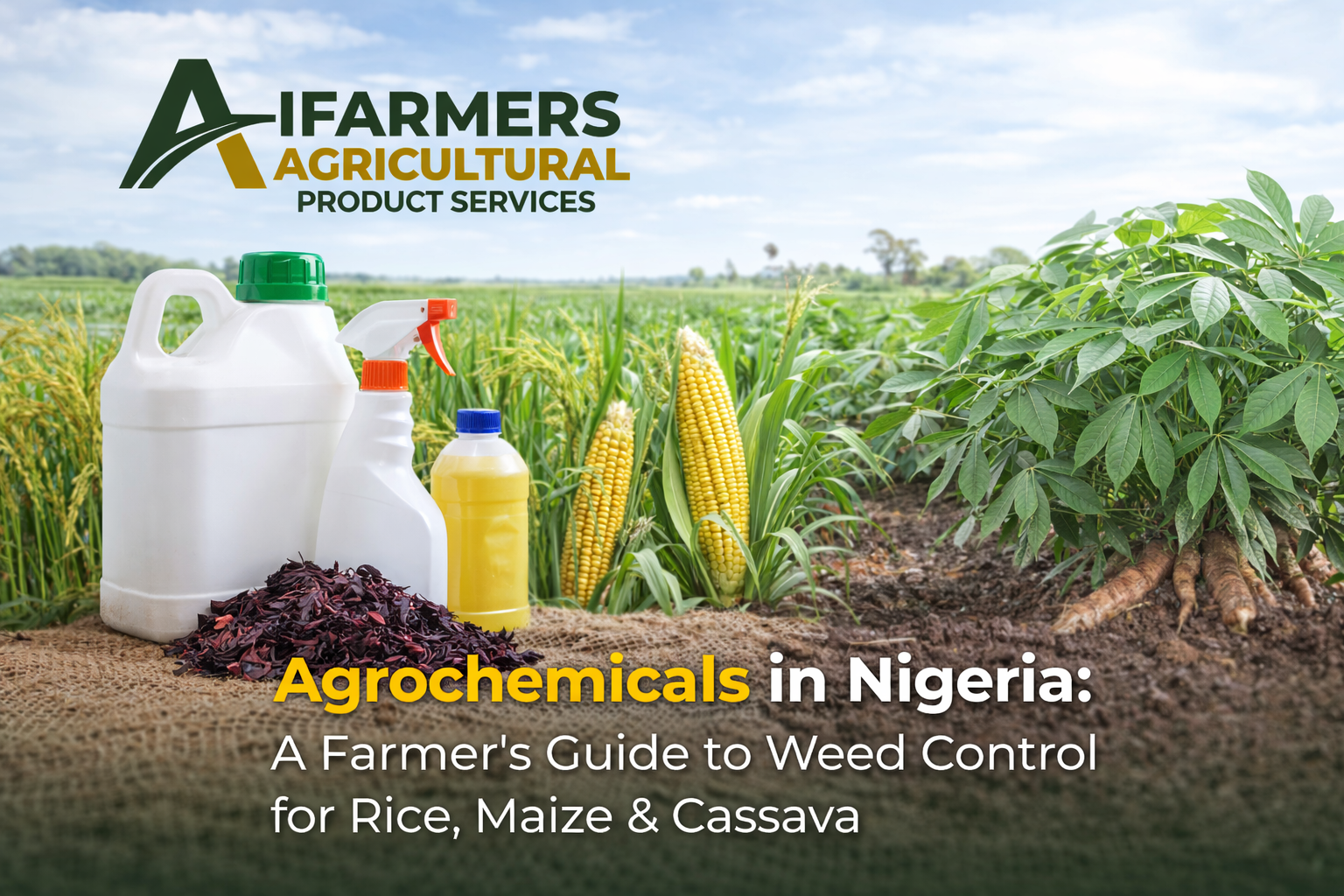
Weeds are one of the most economically damaging threats to crop production in Nigeria. Studies across sub-Saharan Africa consistently show that uncontrolled weed pressure can reduce crop yields by 40 to 80 percent depending on the crop, the weed species, and how early intervention begins. For smallholder farmers already working with tight margins, that level of yield loss is devastating
The good news is that agrochemicals — specifically herbicides — offer a practical, cost-effective solution to weed management when used correctly. The challenge is that many Nigerian farmers either use the wrong product for their crop, apply at the wrong time, or mix products in ways that reduce effectiveness or cause crop damage.
This guide gives you a clear, practical understanding of how herbicides work, which products suit which crops, and how to apply them safely and effectively.
What Are Agrochemicals?
Agrochemicals are chemical products used in agriculture to protect crops, improve yields, and manage pests, diseases, and weeds. The broad category includes:
- Herbicides — used to control weeds
- Insecticides — used to control insect pests
- Fungicides — used to control fungal diseases
- Rodenticides — used to control rodents
- Nematicides — used to control soil-dwelling nematodes that damage roots
This article focuses on herbicides, which are the most widely used agrochemicals among Nigerian crop farmers. Understanding how to select and use herbicides correctly is one of the fastest ways to reduce labour costs and improve your farm's productivity.
Pre-Emergence vs. Post-Emergence Herbicides: The Core Distinction
Before selecting any herbicide, you need to understand the fundamental difference between the two main categories — because using the wrong one at the wrong time will either waste your money or damage your crop.
Pre-Emergence Herbicides:
- Applied to the soil after planting but before weeds have emerged above the ground
- Work by creating a chemical barrier in the topsoil that prevents weed seeds from germinating or kills seedlings as they push through
- Must be applied to moist soil — they require adequate soil moisture to activate and form an effective barrier
- Timing is critical — apply too late (after weeds have already emerged) and they will have little effect
- Common active ingredients include Atrazine, Metolachlor, Pendimethalin, and Oxyfluorfen
Post-Emergence Herbicides:
- Applied after weeds have already germinated and are actively growing
- Absorbed through the weed's leaves and stems and work by disrupting the weed's internal biological processes
- Can be selective (kills specific weed types without harming the crop) or non-selective (kills all vegetation it contacts)
- Timing here is also important — most post-emergence herbicides work best on young, actively growing weeds before they become too mature and difficult to kill
- Common active ingredients include Glyphosate, 2,4-D, Paraquat, Propanil, and Quizalofop-ethyl
A well-structured weed management programme on most Nigerian farms uses both — a pre-emergence application shortly after planting to suppress the first flush of weeds, followed by a targeted post-emergence application to deal with any weeds that break through.
Herbicide Recommendations for Key Nigerian Crops
Rice:
- Pre-emergence: Butachlor or Oxadiazon applied within 3 days of transplanting or direct seeding to suppress grass weeds and broadleaf weeds in the early stages
- Post-emergence: Propanil is one of the most widely used post-emergence herbicides in Nigerian rice farming, effective against a broad range of grass weeds when applied at the 2–3 leaf stage of weeds
- For problem sedge weeds (such as nutgrass/Cyperus species): Bensulfuron-methyl or Halosulfuron-methyl are effective when applied post-emergence
- Always maintain adequate water levels in paddy fields after herbicide application to support effectiveness and reduce weed regrowth
Maize:
- Pre-emergence: Atrazine alone or in combination with Metolachlor is highly effective in maize fields and is among the most commonly recommended pre-emergence options for maize in Nigeria
- Post-emergence (broadleaf weeds): 2,4-D Amine is effective against broadleaf weeds but must only be applied before maize reaches knee height — applying too late causes significant crop injury
- Post-emergence (grass weeds): Nicosulfuron or Foramsulfuron targets grass weed species without harming established maize
- Do not apply Atrazine on sandy soils with low organic matter as it can leach into the root zone and cause crop damage
Cassava:
- Pre-emergence: Diuron or Metribuzin applied shortly after planting before weed emergence suppresses the early weed flush that is most damaging to cassava establishment
- Post-emergence (inter-row): Glyphosate applied carefully as a directed spray between cassava rows — avoiding contact with cassava leaves and green stems — is effective for managing established weeds
- Paraquat can also be used as a directed post-emergence spray in established cassava but requires careful application to avoid contact with cassava foliage
- The critical weed control window for cassava is the first 3 months after planting — this is when weed competition has the greatest impact on final root yield
Soya Bean:
- Pre-emergence: Metribuzin or Pendimethalin applied after planting but before crop and weed emergence
- Post-emergence (grass weeds): Quizalofop-ethyl or Fluazifop-butyl are selective grass herbicides safe for use in soya bean
- Post-emergence (broadleaf weeds): Fomesafen is effective against broadleaf weeds in soya bean without significant crop injury
Safety: Protecting Yourself and Your Farm When Using Herbicides
Herbicides are powerful chemical tools. Used responsibly, they are safe and effective. Used carelessly, they can harm your health, damage your crop, and contaminate your soil and water sources. Always follow these safety principles:
- Wear appropriate Personal Protective Equipment (PPE) — at minimum, wear rubber gloves, a nose/mouth mask, protective eyewear, long-sleeved clothing, and rubber boots when handling and applying herbicides
- Read the product label before every application — the label contains the recommended application rate, timing, safety precautions, and first aid instructions specific to that product
- Never apply herbicides in windy conditions — wind drift carries herbicides onto neighbouring crops, water bodies, and non-target vegetation, causing unintended damage and potential legal liability
- Observe re-entry periods — most herbicide labels specify a period after application during which it is unsafe to re-enter the treated field without PPE. Respect this period.
- Store herbicides safely — keep in original containers, in a locked, ventilated store away from food, water sources, and children. Never transfer herbicides into food or drink containers.
- What to do in case of skin or eye contact — immediately flush the affected area with large amounts of clean water for at least 15 minutes and seek medical attention. Bring the product label to the health facility so medical staff can identify the active ingredient.
- Dispose of empty containers responsibly — triple-rinse empty herbicide containers before disposal and never reuse them for any other purpose, especially not for storing water or food
Common Mistakes Nigerian Farmers Make With Herbicides
Avoiding these errors will save you money and protect your crop:
- Applying post-emergence herbicide when weeds are already too mature — large, established weeds require much higher doses to kill and often recover partially even after treatment. Target young, actively growing weeds for the best results.
- Using non-selective herbicides (like Glyphosate or Paraquat) without directing the spray away from the crop — non-selective herbicides kill everything they contact, including your crop. Always use a hood or shield on your sprayer when applying between rows.
- Using unclean water for herbicide mixing — muddy or turbid water interferes with the chemistry of many herbicides and reduces effectiveness. Always use clean water.
- Underdosing to save money — applying less than the recommended rate encourages herbicide resistance in weed populations and rarely provides adequate control. It is a false economy.
- Ignoring the sprayer calibration — an uncalibrated knapsack sprayer applies inconsistent volumes, resulting in some areas receiving too much chemical and others too little. Calibrate your sprayer at the start of every season.
How Ifarmers Supplies Agrochemicals in Nigeria
Ifarmers Agricultural Products Services Limited is an agrochemical supplier based in Abuja, FCT, serving farmers, cooperatives, and government input distribution programmes across Nigeria.
Our Agro-Input Supply Unit stocks a range of herbicides, insecticides, and fungicides for the major crops grown in Nigeria. As a supplier — not a retail agro dealer — Ifarmers operates at the scale needed to serve bulk buyers, government procurement programmes, and agribusiness operators who require consistent, quality-assured agrochemical supply.
We supply through field agents and logistics coordinators who can reach multiple states, ensuring that quality inputs get to where they are needed.
- Herbicides for rice, maize, cassava, soya bean, and other key crops
- Insecticides for pest management across multiple crop types
- Fungicides for disease control in high-value crops
- Bulk supply for cooperatives, NGOs, and government programmes
Frequently Asked Questions
Can I mix herbicides with fertilizers in the same sprayer tank? In most cases, no. Mixing herbicides with fertilizers in the same spray tank is not recommended as many combinations cause chemical reactions that reduce the effectiveness of both products or create phytotoxic compounds that damage the crop. Always apply herbicides and fertilizers separately unless the product label specifically states that tank mixing is safe with a particular product.
How long does a herbicide remain active in the soil? This varies significantly by active ingredient. Some herbicides like Paraquat break down quickly in the soil within days. Others like Atrazine can persist for several weeks to months, which is why they should not be used excessively in rotation systems where sensitive crops will be planted soon after. Always check the product label for soil persistence information before applying.
Which herbicide kills guinea grass (Panicum maximum) effectively? Guinea grass is one of the most aggressive and persistent weeds on Nigerian farms. For established guinea grass, Glyphosate (non-selective, directed spray) is the most effective option for total knockdown. For in-crop selective control in soya bean or other broadleaf crops, Quizalofop-ethyl or Fluazifop-butyl are effective grass-selective options. In maize, Nicosulfuron is a good selective option for controlling grass weeds including guinea grass.
How do I know if a herbicide product is genuine and not fake? Fake and adulterated agrochemicals are a significant problem in Nigerian markets. To reduce the risk, always purchase from reputable, registered suppliers. Check that the product has a NAFDAC registration number printed on the label, verify the packaging is intact and professionally printed, and be suspicious of products priced significantly below the market rate.
Use Agrochemicals Correctly and Protect Your Yield
Herbicides and agrochemicals, when selected correctly and applied responsibly, are among the most cost-effective investments a Nigerian farmer can make. The difference between a weed-infested farm losing 50% of its potential yield and a well-managed farm achieving its target yield is often simply the timely, correct application of the right herbicide.
Looking for quality agrochemicals for your farm or programme? Contact Ifarmers Agricultural Products Services Limited — a trusted agrochemical supplier in Abuja, FCT, with supply capacity for individual farms, cooperatives, and large-scale government procurement.
📍 Amb. I. Osakwe House, Inner Block St, CBD, Abuja, FCT, Nigeria 🌐 www.ifarmerslimited.com