
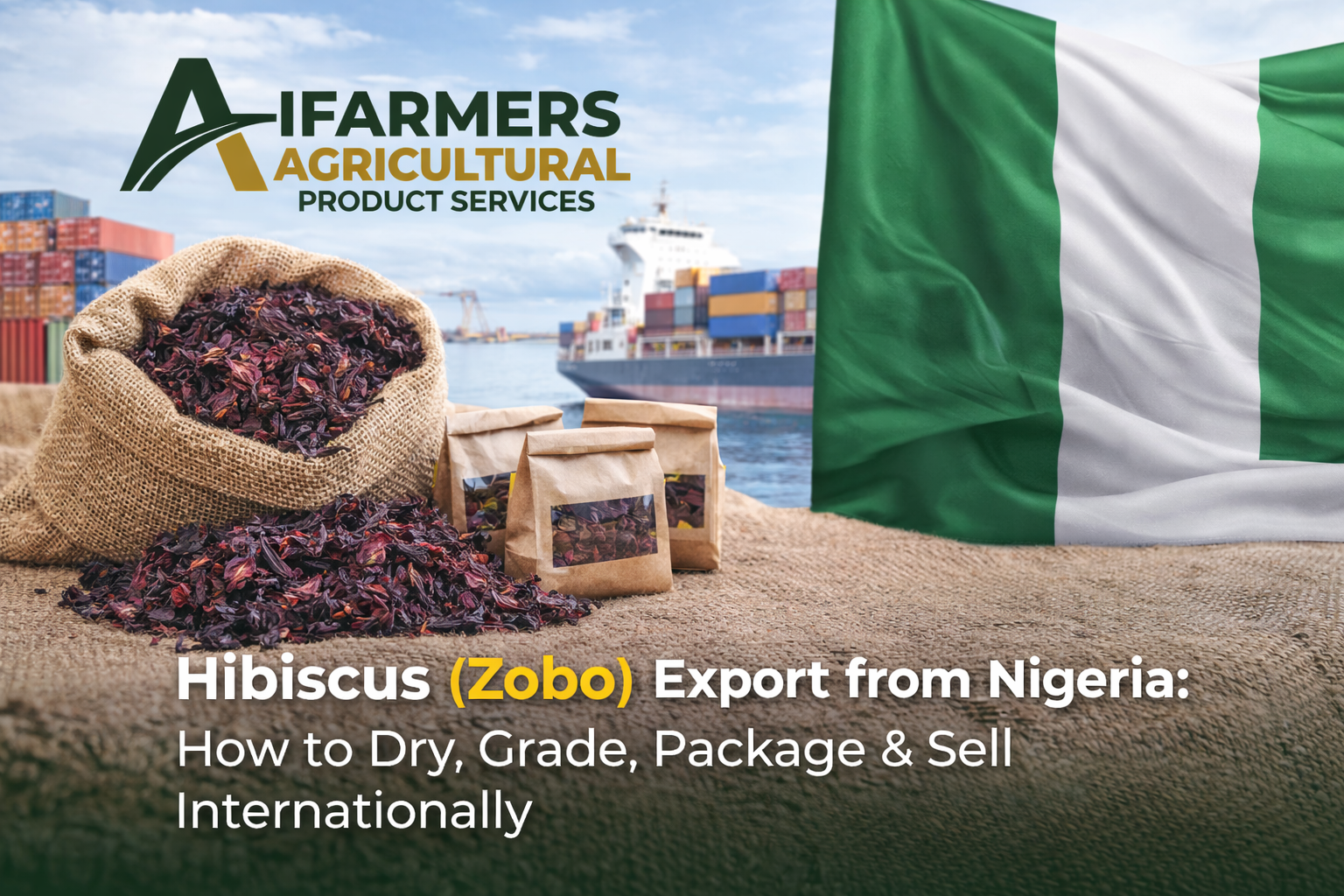
Among Nigeria's agricultural export commodities, dried hibiscus — known locally as zobo — remains one of the most underestimated. While ginger, sesame, and cashew attract the bulk of exporter attention, dried hibiscus calyces quietly command premium prices in the European Union, the United States, Mexico, and across Latin America — and Nigeria is sitting on an enormous untapped supply.
For farmers, traders, and agribusinesses willing to understand the product and meet buyer standards, hibiscus export from Nigeria represents a genuine, high-value opportunity with relatively low entry competition compared to other commodities.
This guide covers everything you need to know — what international buyers are looking for, how to dry and grade hibiscus correctly, packaging requirements, and how to connect with paying buyers abroad.
What Is Hibiscus and Why Is It in High Global Demand?
Hibiscus sabdariffa — called zobo in Nigeria — is a flowering plant whose dried red calyces are harvested and exported as a commodity. It is not the ornamental garden hibiscus most people are familiar with; it is specifically the calyx (the fleshy outer covering of the flower) that has commercial export value.
International demand for dried hibiscus is driven by several industries:
- Herbal tea and beverage industry — Hibiscus tea (also called sorrel tea, agua de jamaica, or karkadé) is widely consumed in Europe, North America, and Latin America as a health beverage known for its deep red colour and antioxidant properties.
- Food colouring and flavouring — The natural deep red pigment in hibiscus calyces is used as a colouring agent in food and beverage manufacturing as a cleaner, natural alternative to synthetic dyes.
- Pharmaceutical and nutraceutical sector — Hibiscus extracts are used in supplements and health products for their reported benefits in supporting cardiovascular health and blood pressure regulation.
- Cosmetics and personal care — Hibiscus extracts are incorporated into skincare and haircare products due to their antioxidant and moisturising properties.
The EU, USA, Germany, Mexico, and Egypt are among the largest importers of dried hibiscus globally. Nigerian hibiscus — grown predominantly in Kano, Jigawa, Bauchi, and Zamfara states — is well regarded for its colour intensity and calyx size, giving it strong marketability when properly processed.
Quality Parameters That Determine Your Export Price
Hibiscus is a premium commodity when quality is right, and a difficult sell when it is not. Your price per kilogram is almost entirely determined by how well your product meets the following quality benchmarks:
- Colour intensity — Deep, vibrant red is what buyers want. Faded, brown, or discoloured hibiscus signals poor harvesting, drying, or storage and will either be rejected or accepted at a steep discount. Colour is the single most important quality indicator for hibiscus buyers.
- Moisture content — Buyers typically require a maximum moisture content of 10–12%. High moisture content leads to mould during transit, which destroys the entire batch. Always dry thoroughly before bagging.
- Foreign matter content — Stems, leaves, sand, insects, and other debris must be kept below 2–3%. Buyers inspect samples upon arrival and will deduct from the agreed price for excessive contamination.
- Whole vs. broken calyces — Whole, intact calyces command higher prices than broken or crushed pieces. Careful handling during harvesting, drying, and bagging preserves calyx integrity.
- Freedom from pesticide residue — Particularly for EU buyers, maximum residue limits (MRLs) for pesticides are strictly enforced. Using unapproved agrochemicals on hibiscus crops can result in shipment destruction and a ban from the buyer's supply chain.
- Absence of mould and aflatoxin — EU buyers in particular may require laboratory test reports confirming your hibiscus is free from mycotoxins. Work with an accredited laboratory to test batches before export.
Drying Methods: How Your Drying Process Affects Quality and Price
One of the most critical — and most commonly mishandled — steps in hibiscus export preparation is drying. The drying method you use directly affects the colour, moisture content, and ultimately the price your product commands.
Sun Drying:
- The most widely used method among Nigerian hibiscus farmers due to low cost
- Calyces are spread on raised drying platforms or clean tarps and dried under direct sunlight
- Risk: Direct harsh sunlight can fade the deep red colour to orange or brown, reducing buyer value significantly
- Best practice: Dry under shade or use shade netting to reduce UV exposure while still allowing air circulation, which preserves colour intensity better than open sun drying
Mechanical/Shade Drying:
- Involves drying in ventilated sheds or using low-temperature mechanical dryers
- Produces more consistent, colour-preserved hibiscus with better moisture control
- More suitable for large-scale operations and exporters targeting premium EU and US buyers
- Higher upfront cost but produces a product that commands meaningfully better prices
Regardless of the method used, always dry hibiscus on clean, raised surfaces. Drying on bare ground introduces sand, stones, and contamination that increase foreign matter content and reduce your grade.
Packaging Requirements for Hibiscus Export
Correct packaging protects your commodity during transit and signals to buyers that you are a professional, reliable supplier. Hibiscus that arrives damp, contaminated, or compressed from poor packaging will be discounted or rejected.
Key packaging guidelines:
- Use new, clean, moisture-resistant woven polypropylene bags or food-grade sacks — never reuse bags that previously held other commodities
- Standard export packaging is typically in bales or bags of 25kg to 50kg net weight, though buyers may specify their preferred pack size
- Each bag or bale must be clearly labelled with: commodity name (Dried Hibiscus Calyces), country of origin (Nigeria), net weight, lot number, harvest year, and exporter details
- Bags must be tightly sewn and sealed to prevent moisture ingress during sea freight
- Ensure your container is clean, dry, and free from odours before loading — hibiscus absorbs smells easily and contamination during transit is difficult to explain to buyers
For EU buyers in particular, packaging may need to comply with specific food-grade material requirements. Confirm packaging specifications with your buyer before loading.
How to Find International Buyers for Nigerian Hibiscus
Hibiscus has a smaller but very focused global buyer pool compared to commodities like sesame or cashew. Here is how to reach them:
- Herbal tea companies and natural ingredient suppliers — Target tea brands and natural ingredient importers in Germany, the Netherlands, France, Mexico, and the USA. Many of these companies actively source hibiscus directly from origin countries and publish procurement contacts on their websites.
- B2B trade platforms — Platforms like Alibaba, Kompass, and TradeKey have buyers listing requests for dried hibiscus regularly. A well-documented seller profile with quality certifications, photos, and clear product specifications will generate serious enquiries.
- NEPC trade facilitation — The Nigeria Export Promotion Council can connect registered Nigerian exporters with verified international buyers through its buyer-matching programmes and export trade events.
- International food and ingredient trade fairs — Events such as Anuga (Germany), SIAL (France), and Natural Products Expo (USA) attract natural ingredient buyers and are excellent venues for establishing direct buyer relationships.
- Partner with a certified agro-exporter — For farmers and smaller-scale operators without existing buyer connections, working with an established, certified exporter like Ifarmers provides immediate access to a buyer network and removes the complexity of managing the export process independently.
Always request a formal purchase contract before committing your commodity, and insist on a Letter of Credit or confirmed payment arrangement for first-time transactions with any buyer.
How Ifarmers Supports Your Hibiscus Export
Ifarmers Agricultural Products Services Limited is a NEPC and NAQS-certified agro-exporter based in Abuja, FCT, with over 7 years of experience exporting agricultural commodities — including dried hibiscus — from Nigeria to international markets.
We work with hibiscus farmers and traders across northern Nigeria to aggregate, grade, and export quality hibiscus calyces on behalf of our clients. Our services include:
- Commodity sourcing and quality grading at origin
- Proper drying, cleaning, sorting, and packaging oversight
- Full export documentation — NEPC, NAQS phytosanitary certificate, and Federal Produce Inspection
- Buyer identification and transaction coordination
- End-to-end logistics from farm gate to destination port
For smaller farmers who cannot independently meet minimum buyer quantity requirements, Ifarmers can aggregate your hibiscus alongside other producers, giving you access to export markets that would otherwise be out of reach.
Frequently Asked Questions
What is the difference between hibiscus calyces and hibiscus petals for export? It is the calyx — the fleshy, deep red outer casing that surrounds the seed pod — that has export value, not the petals. After the hibiscus flower blooms and the petals fall, the calyx swells and is harvested at peak maturity. This is what is dried and exported. Many buyers use the terms interchangeably, but when specifying your product to international buyers, always describe it as "dried hibiscus calyces" or "dried Hibiscus sabdariffa calyces" to avoid confusion.
Why is my hibiscus turning brown during drying? Browning during drying is almost always caused by excessive exposure to direct, harsh sunlight or by drying too slowly in humid conditions. Both destroy the natural red pigments (anthocyanins) in the calyx. To preserve colour, dry under partial shade with good air circulation, ensure calyces are spread in thin, even layers, and complete the drying process quickly to avoid prolonged exposure to humidity.
What quantity do international hibiscus buyers typically require? Most serious buyers — particularly in the EU and USA — require a minimum of one full container load, typically 10 to 15 metric tonnes for dried hibiscus. However, smaller volumes can be exported via groupage (LCL) shipping to test a buyer relationship. Aggregating with other farmers or working through an export partner like Ifarmers helps smaller producers meet minimum order quantities.
Is organic certification necessary for hibiscus export? Organic certification is not mandatory to export hibiscus, but it significantly increases the price you can command, particularly with European herbal tea brands and natural ingredient companies. Certified organic hibiscus can fetch a premium of 20–40% above conventional hibiscus prices. If you are farming on land that has not been treated with synthetic inputs for several years, it may be worth exploring organic certification through accredited bodies.
Start Exporting Nigerian Hibiscus Today
Dried hibiscus is a high-value, growing-demand commodity that many Nigerian exporters are yet to fully explore. Nigeria has the climate, the production capacity, and the raw product quality to compete at the highest levels of the global hibiscus market. What it takes is proper post-harvest handling, correct certification, and the right export partner.
Ready to export hibiscus from Nigeria? Contact Ifarmers Agricultural Products Services Limited — your NEPC and NAQS certified agro-export partner in Abuja, FCT, with the experience and infrastructure to bring your hibiscus to international markets profitably.
📍 Amb. I. Osakwe House, Inner Block St, CBD, Abuja, FCT, Nigeria 🌐 www.ifarmerslimited.com