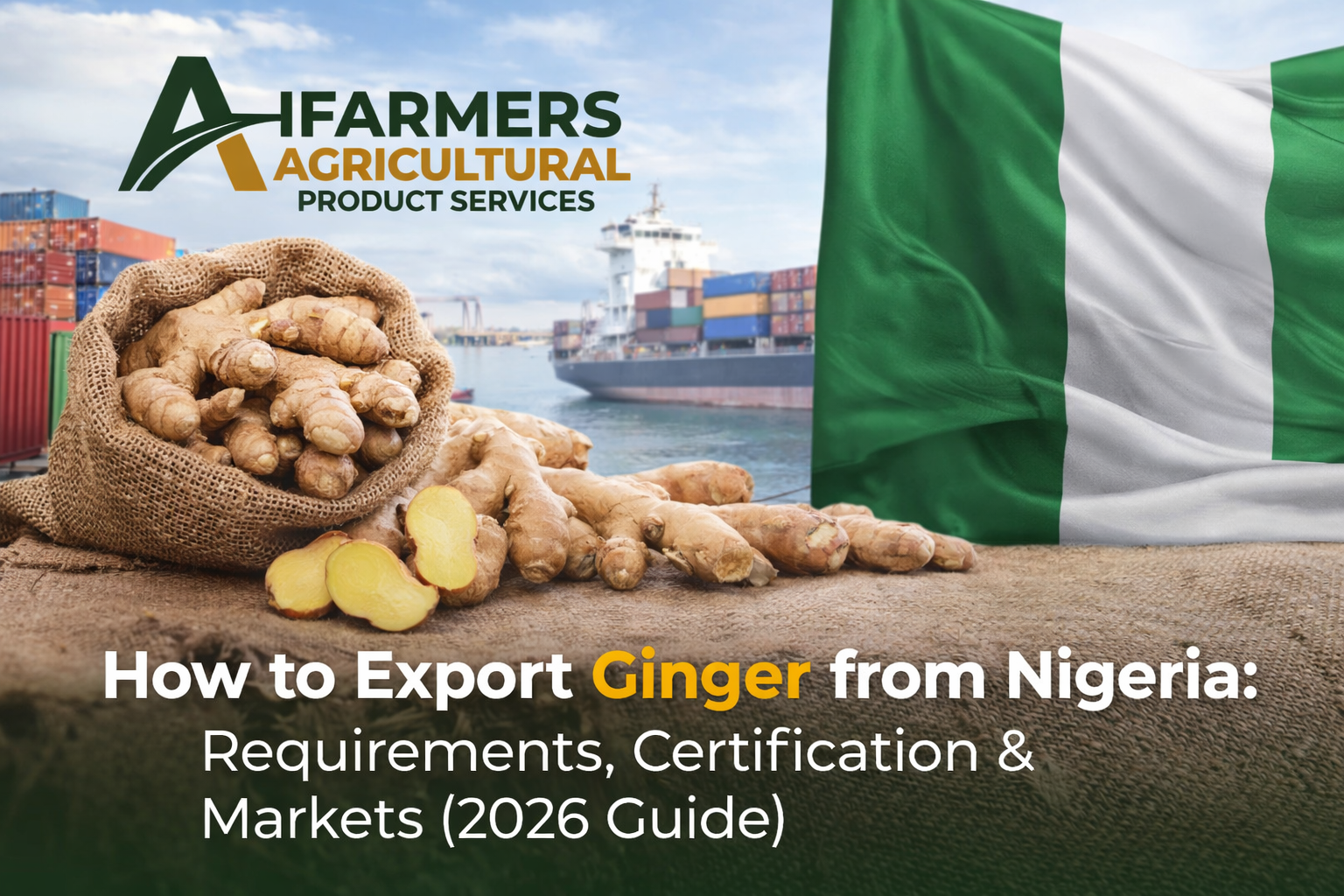
Nigeria is one of the world's top ginger producers, supplying a significant portion of the global market — particularly in dried ginger — to buyers across Europe, Asia, and the Americas. Yet despite this enormous natural advantage, many Nigerian traders and farmers lose out on export opportunities because they lack clear information on how to export ginger from Nigeria correctly. From NEPC registration to NAQS phytosanitary certification, the export process has several critical steps that, if skipped or misunderstood, can result in shipment rejection, financial loss, or legal complications.
This guide walks you through everything you need to know about exporting ginger from Nigeria — the regulatory requirements, certification process, quality standards, packaging guidelines, and the international markets currently buying Nigerian ginger. Whether you are a first-time exporter or an established agribusiness looking to scale, this article gives you a complete picture of what is required.
Ifarmers Agricultural Products Services Limited is a NEPC, NAQS, and Federal Produce Inspection-certified agro-exporter based in Abuja, FCT, with over 7 years of experience facilitating agricultural commodity exports from Nigeria. Contact us to handle your ginger export end-to-end.
Why Nigerian Ginger Stands Out in the Global Market
Nigeria's ginger — grown predominantly in Kaduna, Nasarawa, and Benue states — is well regarded internationally for its high volatile oil content, pungency, and aroma. These characteristics make Nigerian ginger particularly attractive to the spice industry, pharmaceutical manufacturers, and the food and beverage sector worldwide.
The country has historically been one of the world's largest exporters of dried ginger, competing with major producers like India and China. Nigerian ginger's distinct profile gives it a competitive edge in specific markets, especially in Europe and the Middle East, where its quality commands strong buyer interest.
Despite this, a large portion of Nigerian ginger production still goes to waste or is sold domestically at lower values due to poor post-harvest handling and the lack of proper export structures. Exporters who understand the requirements and follow the process correctly are able to tap into a high-value international market.
Step-by-Step: How to Export Ginger from Nigeria Exporting ginger from Nigeria is a structured process that requires you to meet regulatory standards before your commodity can leave the country. Below is a step-by-step overview of the full export process:
Step 1 — Business Registration (CAC)
Before you can engage in any formal export activity, your business must be registered with the Corporate Affairs Commission (CAC) in Nigeria. You can register either as a Business Name or as a Limited Liability Company. For the purposes of export — especially if you intend to access government contracts, export grants, or open corporate bank accounts — a Limited Liability Company structure is strongly recommended.
Step 2 — Tax Identification Number (FIRS)
Following CAC registration, obtain your Tax Identification Number (TIN) from the Federal Inland Revenue Service (FIRS). This is required for opening bank accounts, issuing official receipts, and filing tax returns. Exporters also need a clean tax status to access export incentives such as the Export Expansion Grant (EEG) facilitated through NEPC.
Step 3 — NEPC Registration (Nigeria Export Promotion Council)
NEPC registration is mandatory for all companies wishing to export any commodity from Nigeria. The Nigeria Export Promotion Council serves as the regulatory and promotional body for Nigerian exports. Registration involves submitting your CAC documents, TIN, a passport photograph of the directors, and company profile, among other requirements.
Once registered, you will be issued an NEPC exporter registration certificate and will have access to the Nigerian Export Proceed (NXP) form — a key document required by your bank before any export shipment can proceed. NEPC registration also opens the door to the Export Expansion Grant, export promotion events, and market linkage support.
Step 4 — NAQS Phytosanitary Inspection & Certificate
The Nigeria Agricultural Quarantine Service (NAQS) is responsible for ensuring that agricultural commodities leaving Nigeria meet international plant health standards. For ginger exporters, NAQS will inspect your commodity for pests, disease, and contamination before issuing a Phytosanitary Certificate. This certificate is a legal requirement in almost all destination countries and is checked at the port of entry.
Failing NAQS inspection — or attempting to export without it — results in shipment rejection at destination ports, financial loss, and damage to your reputation as an exporter. Work with NAQS-registered handling facilities and ensure your ginger is properly dried, sorted, and free of foreign matter before presenting it for inspection.
Step 5 — Federal Produce Inspection
The Federal Produce Inspection Service (under the Federal Ministry of Agriculture and Food Security) certifies that your produce meets national and international quality and grading standards. This is particularly important for ginger, where buyers specify moisture content, cleanliness, and freedom from aflatoxin. Always request a grading certificate from the Federal Produce Inspection unit before loading your shipment.
Step 6 — Sourcing, Grading & Quality Control
Quality ginger for export must meet specific standards. Buyers typically specify:
Moisture content: 10–12% maximum for dried ginger
Foreign matter: less than 1–2% (sand, stones, stems)
Freedom from mould, aflatoxin, and pest infestation
Proper cleaning and sorting before bagging
Ginger that does not meet quality specifications will either be rejected by buyers or accepted at a significantly reduced price. Invest in proper drying infrastructure and sorting processes before attempting to export.
Step 7 — Packaging & Labelling
Ginger is typically exported in new, clean jute or sisal bags. Each bag should be properly labelled with the commodity name, net weight, country of origin (Nigeria), lot number, and exporter details. Some buyers — especially in the EU — require specific label formats and may request third-party quality certificates from internationally accredited laboratories.
Step 8 — Shipping Documentation
Work with a licensed freight forwarder to complete your shipping documentation. Key documents include:
- Bill of Lading
- Commercial Invoice
- Packing List
- Certificate of Origin (issued by the Nigerian Association of Chambers of Commerce)
- NAQS Phytosanitary Certificate
- Federal Produce Inspection Certificate
- NEPC NXP Form
- Pre-Shipment Assessment Report (where applicable)
How Ifarmers Can Help You Export Ginger from Nigeria
For many exporters — particularly those entering the market for the first time — navigating the full ginger export process is both time-consuming and complex. Ifarmers Agricultural Products Services Limited exists to simplify this process.
Based in Abuja, FCT, Ifarmers holds all three key export certifications: NEPC registration, NAQS phytosanitary certification, and Federal Produce Inspection accreditation. With over 7 years of active experience in agro-commodity export, our team includes a dedicated Export Coordinator and Documentation Specialist who manage the entire export process on behalf of clients — from commodity sourcing and quality grading to documentation, NAQS inspection, and shipment coordination.
Whether you are a farmer with a surplus of ginger ready for export, a commodities trader looking for a certified export partner, or an agribusiness seeking reliable supply of Nigerian ginger for international buyers, Ifarmers provides end-to-end export services across Nigeria.
Ifarmers has successfully exported agricultural commodities including ginger, sesame, cashew, hibiscus, and soya beans to international markets. We are NEPC and NAQS certified, fully registered with the CAC and FIRS, and have the documentation infrastructure to handle your export from start to finish.
Frequently Asked Questions (FAQ)
Can I export ginger from Nigeria without a licence?
No. Exporting ginger (or any agricultural commodity) from Nigeria without proper registration is illegal and will result in your shipment being seized at the port. You must be registered with the NEPC, obtain a NAQS phytosanitary certificate, and complete the NXP form through your bank before any export can legally proceed.
What is the minimum quantity of ginger I can export?
There is no official government minimum quantity for ginger export, but practically speaking, most international buyers — especially in Europe and Asia — require a minimum of one full container load (approximately 17 to 20 metric tonnes for dried ginger) to make the freight costs commercially viable. Smaller quantities can be exported via groupage/LCL (Less than Container Load) shipping, but this typically incurs higher per-kg freight costs. Aggregating with other exporters through a certified partner like Ifarmers is a practical option for smaller producers.
How long does NAQS phytosanitary inspection take?
The NAQS inspection process typically takes between 3 to 7 working days, depending on the state of origin, the volume of the commodity, and the current workload at the inspection station. It is advisable to present your ginger for inspection well in advance of your planned shipment date to avoid delays. Ifarmers manages this process on behalf of our export clients to ensure timely processing.
What are the quality requirements for exporting ginger to Europe?
Ginger exported to the European Union must comply with EU Regulation (EC) No. 396/2005 on maximum residue levels (MRLs) for pesticides. Additionally, dried ginger must meet moisture content requirements (generally below 12%), have low foreign matter content, and be free from aflatoxin and microbiological contamination. EU buyers may request third-party laboratory test reports as part of their quality assurance process.
Do I need a different certification for each commodity I want to export?
Your NEPC registration covers all agricultural commodities as a general exporter licence. However, NAQS will inspect each specific commodity separately and issue a commodity-specific phytosanitary certificate per shipment. If you intend to export multiple commodities (e.g., ginger and sesame), each shipment will require its own inspection and certificate from NAQS. Federal Produce Inspection certificates are also issued on a per-commodity, per-shipment basis.
Conclusion: Start Your Ginger Export Journey Today
Exporting ginger from Nigeria is a viable and profitable business when approached correctly. Nigeria's position as one of the world's leading ginger producers means the raw material advantage is already there — what separates successful exporters from those who struggle is understanding the regulatory requirements, maintaining consistent quality, and working with the right partners.
The key steps are straightforward: register your business with the CAC and FIRS, obtain your NEPC export licence, submit your commodity for NAQS phytosanitary inspection, meet international quality standards, and ensure your documentation is complete before shipment. Each step matters, and skipping any of them risks financial loss or legal complications.
If you would like to export ginger from Nigeria — or any other agricultural commodity — without the stress of managing the entire process yourself, Ifarmers Agricultural Products Services Limited is your certified, experienced partner in Abuja, FCT.
Ready to Export Ginger from Nigeria?
Contact Ifarmers Agricultural Products Services Limited — your NEPC, NAQS & Federal Produce Inspection certified agro-export partner in Abuja, FCT.
Visit: www.ifarmerslimited.com
Address: Amb. I. Osakwe House, Inner Block St, CBD, Abuja, FCT, Nigeria