
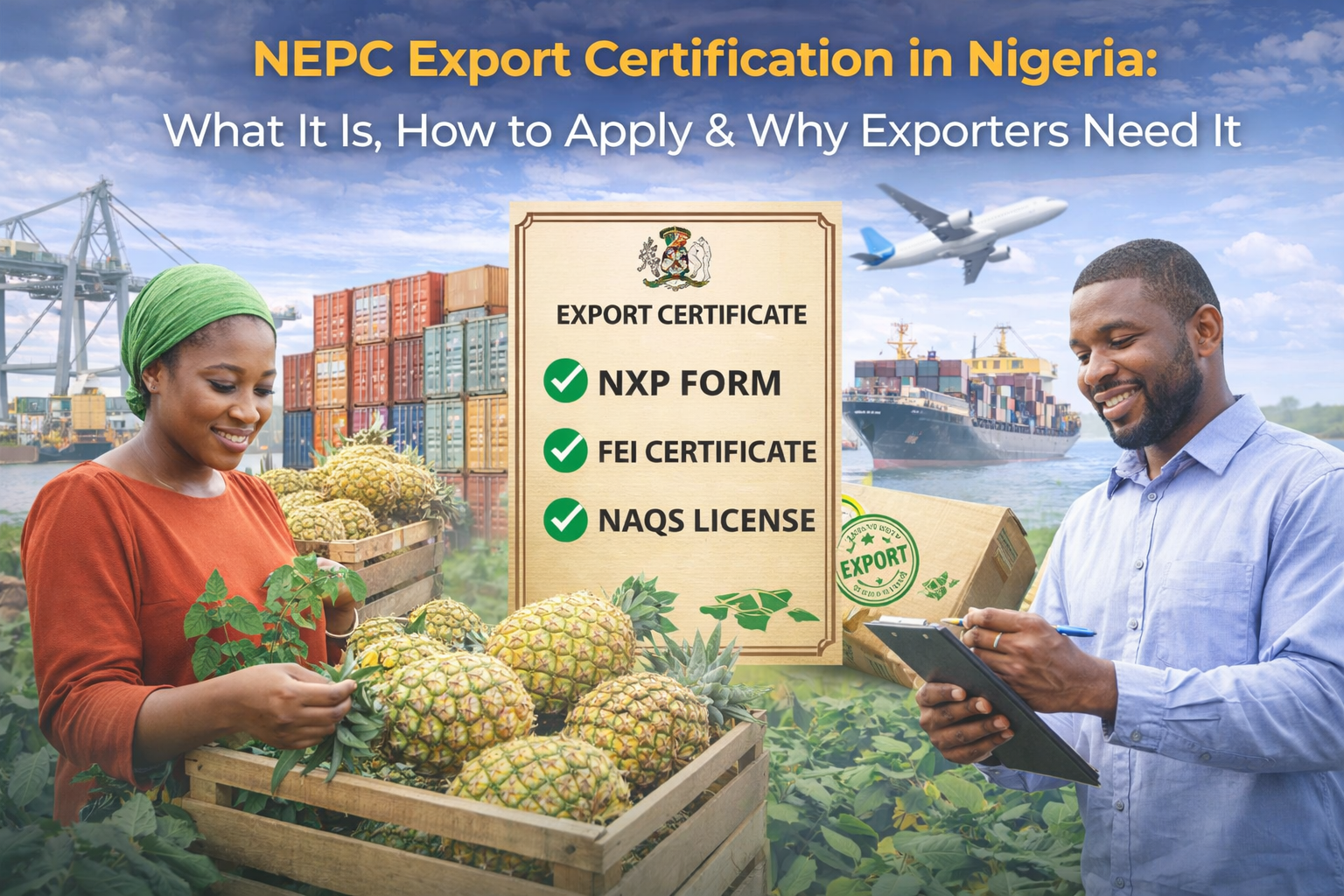
If you want to export any commodity from Nigeria — agricultural produce, manufactured goods, solid minerals, or any other product — there is one registration you cannot legally proceed without: NEPC certification. The Nigeria Export Promotion Council is the federal body that licenses and regulates exporters in Nigeria, and operating as an exporter without its registration is not just commercially limiting — it is illegal.
Yet despite this, a surprising number of Nigerian traders and agribusiness operators attempt to navigate the export market without understanding what NEPC is, what registration involves, or what benefits it unlocks. The result is either illegal export activity that exposes the business to serious risk, or missed opportunities because the company cannot access the export financing, buyer connections, and incentive programmes that NEPC registration makes available.
This guide gives you a clear, complete picture of NEPC export certification in Nigeria — what it is, who needs it, how to apply, how long it takes, and why every serious Nigerian exporter should treat it as a foundational business requirement.
What Is the Nigeria Export Promotion Council (NEPC)?
The Nigeria Export Promotion Council is a federal government agency established under Decree No. 26 of 1976 and subsequently amended by various legislation. It operates under the supervision of the Federal Ministry of Industry, Trade and Investment and has a dual mandate:
- Regulatory — NEPC is the statutory body responsible for registering and licensing all exporters operating from Nigeria. No company or individual can legally export any commodity from Nigeria without being registered with the NEPC.
- Promotional — Beyond regulation, NEPC actively promotes Nigerian exports through trade facilitation, market development, buyer-matching services, export trade fairs, and incentive programmes designed to grow Nigeria's non-oil export earnings.
NEPC maintains offices across Nigeria including its headquarters in Abuja, FCT, and zonal offices in Lagos, Kano, Port Harcourt, and other commercial centres. For agricultural exporters, the NEPC is not just a regulatory hurdle — it is a resource that, when properly leveraged, provides genuine commercial value.
Who Needs NEPC Registration?
NEPC registration is mandatory for any individual or company that intends to export goods from Nigeria, regardless of:
- The type of commodity being exported — agricultural produce, processed food, manufactured goods, solid minerals, textiles, or any other product
- The destination country — whether you are exporting to a neighbouring West African country or to a buyer in Europe or Asia
- The volume of the export — there is no minimum export volume below which NEPC registration is waived
- Whether the export is a one-off transaction or a regular business operation
The only category of export that does not require NEPC registration is personal effects and goods carried by travellers for personal use — not commercial export.
For agricultural exporters specifically, NEPC registration is the first of several certifications required before a shipment can legally leave Nigeria. It works alongside NAQS phytosanitary certification and Federal Produce Inspection certification to form the complete compliance package for agro-commodity export.
What Is the Nigerian Export Proceed (NXP) Form?
One of the most practically important elements of NEPC registration is access to the Nigerian Export Proceed (NXP) form. Understanding what this form is and why it matters is essential for every exporter.
The NXP form is a Central Bank of Nigeria (CBN) mandated document that must be completed and endorsed by your bank before any export shipment can proceed. It serves as the official declaration of an export transaction and is the mechanism through which the CBN tracks foreign exchange inflows from Nigerian exports.
Here is what the NXP form process involves:
- The exporter completes the NXP form with details of the export transaction — commodity, quantity, destination country, buyer details, and expected foreign exchange proceeds
- The form is submitted to the exporter's bank, which endorses it after verifying the exporter's NEPC registration status
- A bank without a valid NEPC registration certificate on file for the exporter will not endorse the NXP form — meaning the export cannot legally proceed
- After the export is completed and payment received, the foreign exchange proceeds must be repatriated through the Nigerian banking system within the timeframe specified by CBN regulations
- Failure to repatriate export proceeds correctly can result in penalties and complications with future export transactions
This is why NEPC registration is not optional even for exporters who might feel they can manage without it — without the registration, no Nigerian bank will process your export transaction, and your shipment cannot leave the country through formal channels.
Step-by-Step: How to Apply for NEPC Registration
The NEPC registration process is conducted primarily online through the NEPC's digital portal. Here is the complete process:
Step 1 — Incorporate Your Business
Before approaching NEPC, your business must be registered with the Corporate Affairs Commission (CAC). NEPC accepts both Business Name registrations and Limited Liability Companies, though an LLC structure is strongly recommended for serious exporters. Ensure your CAC registration is current and your certificate is available before beginning the NEPC process.
Step 2 — Obtain Your Tax Identification Number (TIN)
A valid TIN from the Federal Inland Revenue Service (FIRS) is required as part of the NEPC application. If your company was recently registered with the CAC, your TIN may have been automatically generated — verify this on the FIRS TIN portal before proceeding.
Step 3 — Gather Your Required Documents
Before accessing the NEPC portal, prepare the following:
- CAC Certificate of Incorporation (or Business Name certificate)
- CAC Form CAC 1.1 showing directors and shareholders
- Memorandum and Articles of Association
- Tax Identification Number (TIN)
- Company profile describing your export commodity and business operations
- Passport photographs of the company directors
- Valid means of identification for directors
- Evidence of business address (utility bill or tenancy agreement)
- Bank account details of the company
Step 4 — Register on the NEPC Portal
Visit the NEPC online portal (nepc.gov.ng) and create an account using your company details and email address. Complete the exporter registration form, uploading all required documents in the specified formats. Ensure all information matches exactly what appears on your CAC and FIRS documents — discrepancies cause processing delays.
Step 5 — Pay the Registration Fee
NEPC charges a registration fee that varies by company type and registration category. Payment is made online through the portal. Keep your payment receipt as evidence of completed payment.
Step 6 — Await Processing and Certificate Issuance
Once your application is submitted and payment confirmed, NEPC processes the application. For straightforward applications with complete documentation, processing typically takes between 5 to 15 working days. Once approved, your NEPC exporter registration certificate is issued and accessible through the portal.
Step 7 — Present Your Certificate to Your Bank
With your NEPC certificate in hand, notify your bank and provide a copy for their records. This enables them to endorse NXP forms for your export transactions going forward.
How to Renew Your NEPC Registration
NEPC registration is not a one-time exercise — it must be renewed annually to remain valid. The renewal process follows a similar procedure to initial registration through the NEPC portal:
- Log into your existing NEPC portal account before your current registration expires
- Update any changed company information — director details, address, commodity focus
- Upload any documents that have been updated since your last registration cycle
- Pay the annual renewal fee
- Download your updated registration certificate once renewal is processed
Operating with an expired NEPC certificate is treated the same as operating without registration — your bank will not endorse NXP forms until the renewal is completed. Build the annual renewal into your business calendar well ahead of your certificate expiry date.
NEPC Incentives and Benefits for Registered Exporters
NEPC registration is not just a compliance requirement — it opens the door to a range of tangible commercial benefits that serious exporters should actively leverage:
1. Export Expansion Grant (EEG)
The Export Expansion Grant is a fiscal incentive that provides cash grants to registered Nigerian exporters based on their verified export performance. Exporters who meet the qualifying criteria and submit proper documentation receive a grant calculated as a percentage of their export proceeds — a direct financial reward for growing Nigeria's non-oil export earnings.
2. Buyer-Matching and Market Development Services
NEPC maintains relationships with international buyers, importers, and trade bodies across multiple markets. Registered exporters can access NEPC's buyer-matching services, which connect Nigerian exporters with verified international buyers looking for specific commodities. This is particularly valuable for first-time exporters building their buyer network.
3. Export Trade Fairs and Missions
NEPC organises and participates in international trade fairs and trade missions where Nigerian exporters can exhibit their products and meet buyers face-to-face. Participation opportunities are primarily available to registered exporters. Events cover markets in Europe, Asia, North America, and other African countries.
4. Export Finance Facilitation
NEPC works with financial institutions including the Bank of Industry and NEXIM Bank to facilitate access to export financing for registered Nigerian exporters. Pre-shipment and post-shipment finance products help exporters bridge the cash flow gap between when they need to procure and process their commodity and when they receive payment from the buyer.
5. Export Advisory and Technical Assistance
NEPC provides technical assistance to registered exporters on quality standards, packaging requirements, market entry strategies, and documentation compliance. For agricultural exporters new to specific markets — particularly the EU with its strict MRL and food safety requirements — this advisory support can prevent costly mistakes.
Ifarmers' NEPC Certification: A Case Study in Export Compliance
Ifarmers Agricultural Products Services Limited is a fully NEPC-registered agro-exporter based in Abuja, FCT, with over 7 years of experience exporting agricultural commodities including ginger, sesame seed, cashew, hibiscus, soya beans, and tigernut to international markets.
Our NEPC registration is one of the three core export certifications we hold alongside NAQS phytosanitary certification and Federal Produce Inspection accreditation. These certifications are not administrative decorations — they are the operational foundation that allows us to execute export transactions legally, access buyer markets, process NXP forms through our bank, and provide our export clients with the documented compliance assurance that international buyers require.
For businesses and farmers who want to export Nigerian agricultural commodities but do not want to navigate the certification and compliance process themselves, Ifarmers provides end-to-end export services — handling all regulatory requirements, documentation, inspection, and logistics on behalf of our clients.
Frequently Asked Questions
Is NEPC registration mandatory for all exporters regardless of export volume? Yes. There is no minimum export volume threshold below which NEPC registration is waived. Whether you are exporting one tonne of ginger or one thousand tonnes of sesame seed, NEPC registration is legally required before your bank will process the NXP form and your shipment can proceed through formal export channels.
How long does NEPC registration take? For applications with complete, accurate documentation submitted through the NEPC online portal, processing typically takes between 5 to 15 working days. Applications with incomplete documentation, discrepancies between submitted documents, or outstanding queries from NEPC officers take longer. Ensure all your documents are in order before submitting to avoid delays.
Can a Business Name registration (not a Limited Liability Company) register with NEPC? Yes, NEPC accepts Business Name registrations. However, for exporters who intend to scale their business, access export financing facilities, participate in government incentive programmes, or build long-term buyer relationships with institutional purchasers, incorporating as a Limited Liability Company is strongly advisable. Most serious international buyers and development partner organisations prefer or require dealing with incorporated entities.
What is the NXP form and do I need it for every shipment? The Nigerian Export Proceed form is a CBN-mandated document that must be completed and endorsed by your bank for every export transaction. It is not a one-time form — a new NXP form is required for each individual shipment. Your bank will only endorse NXP forms for exporters with a current, valid NEPC registration certificate on file.
What happens if I export without NEPC registration? Exporting without NEPC registration is illegal under Nigerian export law. Practically speaking, your bank will not endorse NXP forms without a valid NEPC certificate, meaning you cannot process your export through formal banking channels. Attempting to export through informal channels exposes you to seizure of goods at the port, legal prosecution, and permanent reputational damage with buyers, shipping lines, and Nigerian regulatory agencies.
Does NEPC registration cover all the certifications I need to export agricultural produce? No. NEPC registration is the first and foundational export certification but it is not the only one required for agro-commodity export. You will also need a NAQS phytosanitary certificate for each shipment confirming your commodity is free from pests and disease, and a Federal Produce Inspection certificate verifying your commodity meets national quality and grading standards. These three certifications together constitute the core compliance package for agricultural commodity export from Nigeria.
Get Your NEPC Registration Right — From the Start
NEPC export certification is the foundation of every legitimate export business in Nigeria. Getting it right — obtaining the registration before you need it, maintaining it through annual renewals, and actively leveraging the incentives and services it unlocks — is not a bureaucratic exercise. It is a commercial investment that pays dividends across every export transaction you complete.
Ready to export Nigerian agricultural commodities but need a certified partner to handle the compliance and logistics? Contact Ifarmers Agricultural Products Services Limited — a fully NEPC, NAQS, and Federal Produce Inspection certified agro-exporter in Abuja, FCT, with over 7 years of proven export experience.
📍 Amb. I. Osakwe House, Inner Block St, CBD, Abuja, FCT, Nigeria 🌐 www.ifarmerslimited.com