
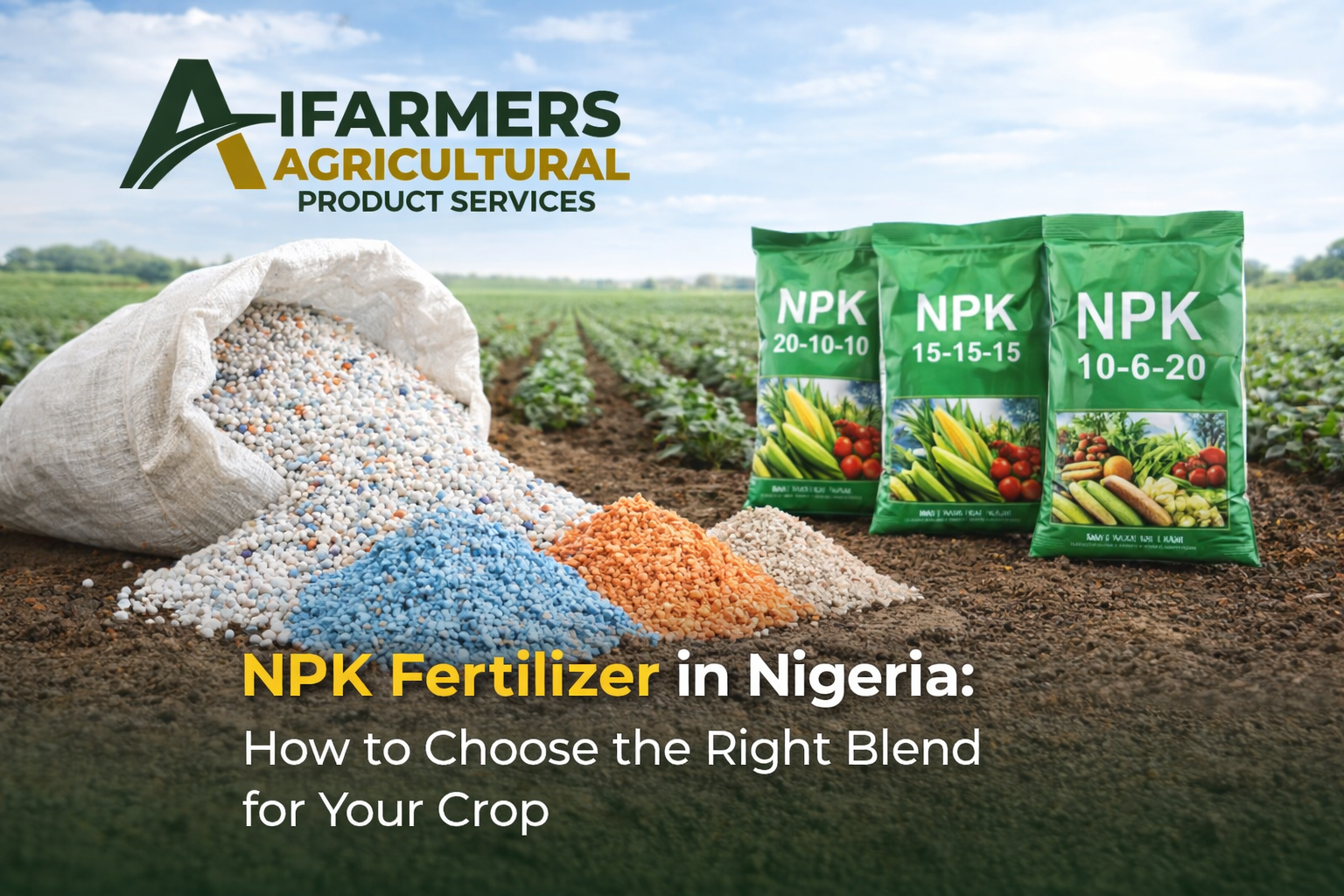
Choosing the right NPK fertilizer blend is not complicated once you understand what the numbers mean and what each crop actually needs. This guide breaks it down clearly — so that whether you are growing rice in the Niger Delta, maize in Kaduna, or cassava in Benue, you know exactly what to apply and why.
What Do NPK Numbers Actually Mean?
NPK stands for Nitrogen (N), Phosphorus (P), and Potassium (K) — the three primary macronutrients that crops need in significant quantities to grow, develop, and produce good yields. Every bag of NPK fertilizer carries three numbers on the label, such as 15:15:15 or 20:10:10. These numbers represent the percentage by weight of each nutrient in that bag.
So a 50kg bag of NPK 15:15:15 contains:
- 7.5kg of Nitrogen (N) — supports leafy, vegetative growth and gives plants their green colour
- 7.5kg of Phosphorus (P) — drives root development, flowering, and fruiting
- 7.5kg of Potassium (K) — strengthens the plant's immune system, improves drought resistance, and enhances fruit and grain quality
The remaining weight in the bag is filler material (carrier) that helps distribute the nutrients evenly.
When the three numbers are equal — like 15:15:15 — it is called a balanced or straight compound fertilizer. When one number is higher than the others — like 20:10:10 — it means that nutrient is present in a greater proportion, which is useful for crops with a specific dominant nutritional need.
Understanding this simple principle is the foundation of making better fertilizer decisions for your farm.
Why Using the Wrong NPK Blend Hurts Your Yield
Many Nigerian farmers default to NPK 15:15:15 for every crop because it is the most widely available and familiar option. While it is a useful general-purpose fertilizer, it is not always the best fit for every crop or every growth stage.
Here is what goes wrong when the blend is mismatched:
- Applying too much nitrogen at the wrong time — Excess nitrogen encourages excessive leafy growth at the expense of fruiting and grain filling. On crops like maize and rice, this means tall, lush plants that produce disappointing grain yields.
- Insufficient phosphorus at planting — Phosphorus is critical in the early stages of crop growth for root establishment. Applying a blend low in phosphorus at planting leads to weak root systems that cannot efficiently absorb water and other nutrients later in the season.
- Low potassium in drought-prone areas — Potassium regulates the opening and closing of plant pores (stomata), which controls water loss. Crops grown in drier parts of Nigeria without adequate potassium are far more vulnerable to heat and moisture stress.
- Wasted input cost — Buying a more expensive or higher-analysis fertilizer than your soil and crop actually require is simply money wasted. A soil test followed by the right blend selection often reduces fertilizer costs while improving yield.
Recommended NPK Blends for Key Nigerian Crops
Different crops have different nutritional priorities. Below are the commonly recommended NPK blends for the major crops grown across Nigeria:
Maize:
- At planting: NPK 15:15:15 or NPK 12:24:12 to support root development and early growth
- At 4–6 weeks (top dressing): Urea (46:0:0) or CAN (26:0:0) to boost vegetative growth and grain development
- Maize is a heavy nitrogen feeder, so split nitrogen application — some at planting, more at top dressing — gives the best results
Rice (Paddy):
- Basal application: NPK 15:15:15 or NPK 20:10:10 at transplanting or early tillering
- Top dressing: Urea at active tillering stage and again at panicle initiation
- Rice production in Nigeria responds strongly to nitrogen timing — applying too late or too early reduces grain filling
Cassava:
- NPK 12:12:17 or NPK 10:10:20 are well suited to cassava's high potassium demand
- Cassava is a root crop and stores energy as starch in its tubers — potassium directly supports this starch accumulation process
- Avoid high nitrogen blends on cassava as excess nitrogen promotes top growth at the expense of root bulking
Soya Bean:
- Soya bean is a legume that fixes its own nitrogen through root bacteria, so it requires less nitrogen fertilizer than cereals
- Apply NPK 0:20:20 or SSP (Single Super Phosphate) at planting to support root nodule development and phosphorus needs
- A starter dose of low-nitrogen NPK at establishment can boost early growth before nitrogen fixation kicks in
Vegetables (Tomato, Pepper, Onion):
- NPK 15:15:15 at transplanting to support balanced establishment
- Switch to a higher potassium blend (such as NPK 12:12:17 or NPK 13:13:21) at fruiting stage to improve fruit size, colour, and shelf life
- Vegetables are high-value crops that respond well to fertilizer investment — but over-application of nitrogen leads to blossom drop and reduced fruit set
The Case for Custom NPK Blending
One of the most significant advances available to Nigerian farmers — particularly large-scale operators, cooperatives, and state agriculture programmes — is custom fertilizer blending. Rather than accepting a generic compound fertilizer formulation that may or may not suit your soil, custom blending produces an NPK ratio that is specifically designed for your soil type, your crop, and your target yield.
The process works as follows:
- Soil testing — A soil sample from your farm is sent to an accredited laboratory for analysis. The results reveal your soil's existing nutrient levels, pH, and deficiencies.
- Nutrient recommendation — An agronomist or fertilizer specialist reviews the soil test results and calculates the exact nutrient balance your crop needs.
- Custom blending — The recommended formulation is blended using base materials (Urea, DAP, MOP, SSP, etc.) in precise ratios to produce a bespoke NPK blend.
- Quality control and delivery — The blended fertilizer is tested, bagged, and delivered ready for application.
Ifarmers Agricultural Products Services Limited operates a Fertilizer Blending Unit and partners with Greenwell Fertilizer, Matrix Fertilizer, and United Fertilizer as blending partners. This partnership structure enables us to supply custom NPK blends tailored to specific crops, soil conditions, and farm scales — from individual large-scale farmers to state agriculture ministries and development organisations requiring bulk input supply.
Custom blending is particularly cost-effective for farms above 50 hectares and for government or NGO programmes distributing inputs to large numbers of smallholder farmers across specific agro-ecological zones.
How to Apply NPK Fertilizer Correctly
Even the right fertilizer blend will underperform if applied incorrectly. Here are the key application principles every Nigerian farmer should follow:
- Apply at the right growth stage — Basal fertilizer (applied at planting) should go into the soil before or at the time of seeding or transplanting. Top dressing fertilizer should be applied when the crop has established and is actively growing — not too early, not too late.
- Do not apply to dry soil — Fertilizer applied to very dry soil risks burning the plant roots and will not be absorbed effectively. Apply when the soil has some moisture, or apply ahead of expected rainfall.
- Keep fertilizer away from the stem — Apply NPK in a ring or band around the plant, not directly touching the stem or trunk. Direct stem contact can cause fertilizer burn.
- Follow recommended rates — More fertilizer is not always better. Over-application wastes money, damages soil health over time, and can cause crop toxicity. Follow the recommended kg per hectare for your crop.
- Store fertilizer correctly — Store bags in a cool, dry, well-ventilated shed on raised pallets, away from direct sunlight and moisture. Poorly stored fertilizer cakes, loses potency, and becomes difficult to apply evenly.
How Ifarmers Supplies NPK Fertilizer in Nigeria
Ifarmers Agricultural Products Services Limited is a fertilizer supplier based in Abuja, FCT, serving individual farmers, farming cooperatives, agribusinesses, and government procurement programmes across Nigeria.
As a supplier — not a retail agro dealer — Ifarmers operates at scale, supplying NPK, Urea, SSP, and custom-blended fertilizers in bulk to clients who need reliable, quality-assured inputs. Through our partnerships with Greenwell Fertilizer, Matrix Fertilizer, and United Fertilizer, we are able to offer:
- Standard NPK compound fertilizers (15:15:15, 20:10:10, and other common formulations)
- Straight fertilizers including Urea (46:0:0) and Single Super Phosphate (SSP)
- Custom NPK blends produced to specific crop and soil requirements
- Bulk supply for large farms, cooperatives, state agriculture ministries, and NGO input distribution programmes
We combine supply capability with agronomic knowledge — meaning our clients do not just receive fertilizer, they receive guidance on what to apply, when to apply it, and how to maximise their return on every bag.
Frequently Asked Questions
What is the difference between NPK 15:15:15 and NPK 20:10:10? NPK 15:15:15 is a balanced fertilizer with equal parts nitrogen, phosphorus, and potassium, making it a useful general-purpose option for many crops at establishment. NPK 20:10:10 is a nitrogen-dominant blend better suited to crops with high nitrogen demand — such as maize at the vegetative growth stage — where you want to push leafy, vigorous growth before flowering and grain filling begin.
How do I know which NPK blend my farm needs? The most accurate way to determine the right fertilizer blend for your farm is through a soil test. A soil test identifies your existing nutrient levels and pH, which allows an agronomist to recommend the exact formulation your crop needs. Without a soil test, you can follow the general crop-specific recommendations in this article as a starting point, but custom recommendations based on your specific soil will always outperform generic advice.
Can I mix different fertilizers together? Some fertilizers can be mixed and others cannot. For example, Urea should not be mixed with Single Super Phosphate (SSP) as the combination triggers a chemical reaction that causes nitrogen loss. When in doubt, apply fertilizers separately rather than mixing them. Always consult an agronomist or your fertilizer supplier before attempting to blend products yourself.
How much NPK fertilizer should I apply per hectare? Application rates vary by crop, expected yield target, and soil fertility level. As a general guide, most cereal crops in Nigeria (maize, rice, sorghum) respond to basal NPK applications of 250–350kg per hectare, supplemented by Urea top dressing. For vegetables and high-value crops, rates are typically lower but applications are more frequent. Your fertilizer supplier or extension officer can provide crop-specific rate recommendations.
Get the Right Fertilizer for Your Farm
Choosing the right NPK fertilizer blend is one of the highest-impact decisions you make as a farmer or agribusiness operator. It directly affects your yield, your input cost efficiency, and ultimately your profit per hectare. The good news is that with the right knowledge and the right supplier, it does not have to be complicated.
Ready to order quality NPK fertilizer or explore custom blending for your farm or programme? Contact Ifarmers Agricultural Products Services Limited — a trusted fertilizer supplier in Abuja, FCT, serving farmers, cooperatives, and government agencies across Nigeria.
📍 Amb. I. Osakwe House, Inner Block St, CBD, Abuja, FCT, Nigeria 🌐 www.ifarmerslimited.com 📞 [Insert WhatsApp Number]
Written by Alderwood Management Limited on behalf of Ifarmers Agricultural Products Services Limited. Explore related articles: Agrochemicals in Nigeria, How to Access Subsidised Fertilizer Through Government Programmes, and Custom Fertilizer Blending in Nigeria — all on the Ifarmers blog.