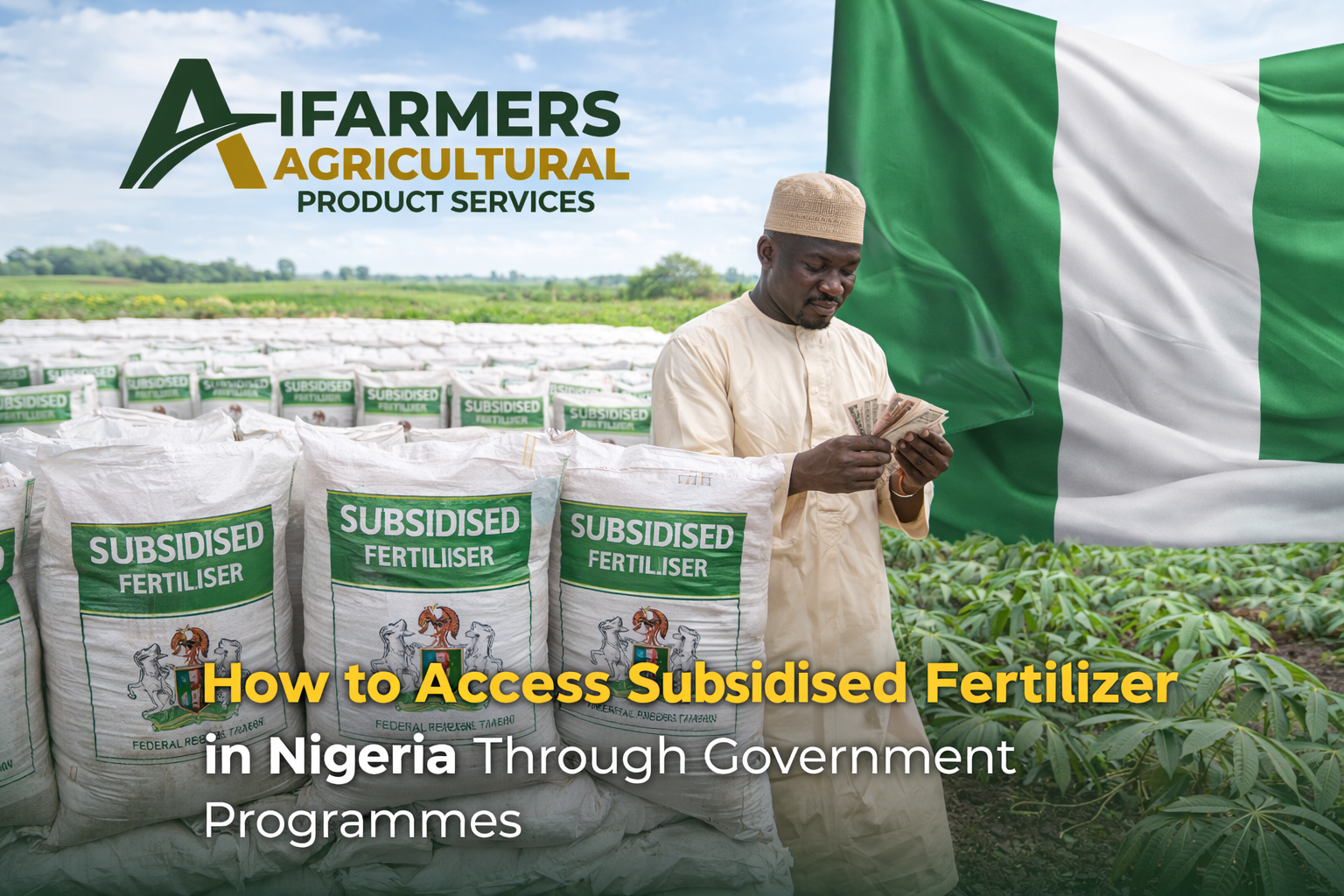
For millions of Nigerian farmers, fertilizer is the single largest input cost in their farming operation — and in recent years, rising prices have made it increasingly difficult for smallholder farmers to purchase the quantities their crops actually need. The Nigerian government, recognising this challenge, has put in place several subsidy and intervention programmes designed to make fertilizer more affordable and accessible to farmers across the country
The problem is that many farmers either do not know these programmes exist, do not understand how to access them, or have had poor experiences with previous subsidy schemes that were poorly implemented. This guide gives you a clear, honest picture of how government fertilizer subsidy programmes in Nigeria work, how to register and access them, and what to do when the programmes fall short.
Why the Government Subsidises Fertilizer
Fertilizer subsidies in Nigeria are not new. The government has intervened in fertilizer supply and pricing in various forms since the 1970s, recognising that food security and agricultural productivity depend on farmers being able to afford quality inputs.
The core logic is straightforward:
- Fertilizer at full commercial price is often out of reach for smallholder farmers operating on less than two hectares
- Without adequate fertilizer, crop yields remain low, food production is insufficient, and rural poverty deepens
- By subsidising a portion of the fertilizer cost, the government aims to boost agricultural productivity, increase food supply, and improve farmer incomes simultaneously
Nigeria's current fertilizer intervention programmes are administered primarily through the Federal Ministry of Agriculture and Food Security and implemented in partnership with state governments, approved input suppliers, and agricultural development agencies. The specific structure and reach of these programmes can change from year to year depending on budget allocations and policy direction, which is why staying informed and registered is essential for any farmer wishing to benefit.
Key Government Fertilizer Programmes in Nigeria
1. The Presidential Fertilizer Initiative (PFI)
The Presidential Fertilizer Initiative was launched to revive blending plants across Nigeria and produce affordable NPK fertilizer locally rather than relying entirely on imports. Under this programme, raw fertilizer materials are procured and supplied to local blending companies at subsidised rates, which in turn produce NPK fertilizer for sale to farmers at below-market prices.
The PFI has significantly increased local fertilizer blending capacity in Nigeria and reduced dependence on imported compound fertilizers. Farmers benefit indirectly through lower market prices when the programme is active and well-funded.
2. State Government Input Distribution Programmes
Most Nigerian state governments run their own annual input distribution programmes, typically timed to coincide with the planting seasons. These programmes distribute subsidised fertilizer — and often seeds and agrochemicals — either free of charge or at heavily subsidised prices to registered farmers in the state.
Access is typically managed through:
- State Ministries of Agriculture and their local government field offices
- Agricultural Development Programmes (ADPs), which operate in virtually every state
- Farmers' cooperatives and registered farmer groups that serve as distribution points
The scale, quality, and consistency of these state programmes vary significantly. Some states have well-organised, transparent distribution systems while others struggle with logistics, diversion of inputs, and delays.
3. The e-Wallet and Digital Input Distribution Systems
Nigeria has experimented with electronic wallet systems for fertilizer distribution — most notably under the Growth Enhancement Support (GES) Scheme — where registered farmers receive digital vouchers redeemable at approved input dealers rather than receiving physical bags of fertilizer through government channels.
The e-wallet approach was designed to reduce the diversion of subsidised fertilizer to non-farmers and to give farmers more flexibility in choosing where to redeem their inputs. Under such systems:
- Farmers register with their BVN (Bank Verification Number) and phone number
- A subsidy voucher or e-wallet credit is issued to the farmer's mobile number
- The farmer redeems the voucher at an approved input redemption point to collect their subsidised fertilizer
Not all states currently operate active e-wallet schemes, and the federal-level scheme has gone through several iterations. Check with your State Ministry of Agriculture or ADP office to confirm whether an active e-wallet programme is running in your state during the current season.
4. Development Partner and NGO Input Programmes
Beyond government programmes, several international development organisations — including USAID, the Bill & Melinda Gates Foundation, IFAD, and the World Bank — fund input subsidy and distribution programmes in Nigeria through implementing partners. These programmes often target specific states, specific crops, or specific farmer categories (women farmers, youth farmers, etc.) and are worth investigating through your local ADP or cooperative.
How to Register and Access Subsidised Fertilizer
Regardless of the specific programme, the registration process for government fertilizer subsidy access in Nigeria follows a broadly similar pattern:
- Visit your Local Government Area (LGA) Agriculture Office — This is your first point of contact. The LGA agriculture office maintains farmer registration lists and can confirm which active programmes are available in your area during the current season.
- Register as a farmer with your State ADP — Agricultural Development Programmes maintain farmer databases used to allocate subsidised inputs. If you are not yet registered, visit your nearest ADP office with your valid ID, proof of farming activity, and your BVN.
- Join a registered cooperative or farmer group — Many state and federal programmes distribute subsidised inputs through registered cooperatives rather than to individual farmers. Being a member of a registered cooperative significantly increases your chances of accessing subsidised fertilizer reliably.
- Provide your BVN and mobile number — For any programme operating an e-wallet or digital voucher component, your BVN and active mobile number are required for registration. Ensure your phone number is active and accessible.
- Confirm redemption centres near you — Once registered, ask your LGA office or ADP extension officer to confirm the approved input redemption centres in your area and the schedule for distribution. Arriving early during distribution windows is important as quantities are often limited.
- Follow up actively — Government programme information does not always reach farmers proactively. Stay in contact with your LGA agriculture office, listen to state government announcements, and connect with your cooperative leadership to stay informed when distributions are scheduled.
Common Challenges and Practical Alternatives
It is important to be honest: government fertilizer subsidy programmes in Nigeria, while valuable in principle, are not always reliable in practice. Common challenges include:
- Delays in distribution — Fertilizer often arrives after the optimal planting window has passed, reducing the agronomic benefit even when access is eventually granted
- Diversion and leakage — Subsidised fertilizer intended for farmers sometimes ends up being sold at market prices by intermediaries, reducing what actually reaches the intended beneficiary
- Insufficient quantities — Registered farmers frequently receive less than what their farm size actually requires, making the subsidy a supplement rather than a complete solution
- Poor quality inputs — In some cases, distributed fertilizer has been found to be expired, adulterated, or mislabelled, delivering little to no agronomic benefit
Given these realities, the most resilient approach for Nigerian farmers is to treat government subsidies as a welcome supplement — not the primary plan. Where subsidy access is delayed or insufficient, sourcing quality fertilizer directly from a reliable, registered supplier ensures your crops are not left without the inputs they need during the critical planting window.
How Ifarmers Supports Fertilizer Access in Nigeria
Ifarmers Agricultural Products Services Limited is a fertilizer supplier based in Abuja, FCT, with a track record of supplying NPK, Urea, SSP, and custom-blended fertilizers to farmers, cooperatives, state government agencies, and development organisations across Nigeria.
Through our partnerships with Greenwell Fertilizer, Matrix Fertilizer, and United Fertilizer as blending partners, Ifarmers is positioned to supply quality fertilizer at scale — including to government and NGO programmes that require a reliable, documented input supplier for their distribution activities.
For farmers and cooperatives who need fertilizer outside of subsidy windows, or in quantities greater than what government programmes provide, Ifarmers offers:
- Direct bulk fertilizer supply to cooperatives and farmer groups
- Custom NPK blending for state agriculture programmes and large-scale operators
- Supply of NPK, Urea, SSP, and agrochemicals for government input distribution programmes
- Reliable logistics and documentation to support procurement processes
We are not a retail agro dealer — we are a supplier that operates at the scale required by serious agricultural programmes and large farming operations.
Frequently Asked Questions
Is it mandatory to have a BVN to access government fertilizer subsidies in Nigeria? For most digital or e-wallet based subsidy programmes, yes — a BVN is required to register and receive a digital voucher. However, some state programmes still distribute physical inputs through cooperatives and LGA offices without requiring a BVN. Check with your local LGA agriculture office or ADP for the specific requirements of programmes running in your state.
How do I know if I qualify for the government fertilizer subsidy? Eligibility criteria vary by programme, but most government fertilizer subsidy schemes in Nigeria target smallholder farmers — typically those farming between 0.5 and 5 hectares. You generally need to be a resident of the state running the programme, be registered with your LGA agriculture office or ADP, and in some cases be a member of a registered cooperative. First-time applicants should visit their nearest LGA agriculture office to confirm current eligibility requirements.
What should I do if the subsidised fertilizer I received is of poor quality? Report the issue immediately to the LGA agriculture office or ADP extension officer who managed your distribution, and if possible, collect a sample of the suspect fertilizer in a sealed bag for testing. Document the lot number and source of the fertilizer. You can also report quality concerns to the National Agricultural Seeds Council (NASC) or the relevant state ministry. As an alternative, sourcing your fertilizer directly from a registered, reputable supplier like Ifarmers eliminates the quality uncertainty associated with some government distribution channels.
Can a cooperative access subsidised fertilizer on behalf of its members? Yes. In most state and federal programmes, registered cooperatives are formal distribution points for subsidised inputs and can receive bulk allocations on behalf of their members. This is one of the strongest reasons to be an active member of a registered cooperative — it increases both access and allocated quantities compared to individual farmer registration.
Stay Informed and Plan Ahead
Government fertilizer subsidy programmes can meaningfully reduce your input costs when they are accessed correctly and on time. The key is to stay registered, stay connected with your LGA agriculture office and cooperative, and never rely entirely on a subsidy programme arriving on schedule before your planting window closes.
Need reliable fertilizer supply outside of government programme timelines? Contact Ifarmers Agricultural Products Services Limited — a trusted fertilizer supplier in Abuja, FCT, supplying NPK, Urea, SSP, and custom-blended fertilizers to farmers, cooperatives, and government programmes across Nigeria.
📍 Amb. I. Osakwe House, Inner Block St, CBD, Abuja, FCT, Nigeria 🌐 www.ifarmerslimited.com 📞 [Insert WhatsApp Number]
Written by Alderwood Management Limited on behalf of Ifarmers Agricultural Products Services Limited. Explore related articles: NPK Fertilizer in Nigeria, Agrochemicals in Nigeria, and Custom Fertilizer Blending in Nigeria — all on the Ifarmers blog.